|
 Attendee
Information Attendee
Information
Following is a list of ITAC meeting attendees/invitees who plan on attending
the meeting:
|
|
Marilyn Billone
|
ITAC Executive
Secretary -- Reston, VA
|
Attended
|
|
Donna Hector-Sabin
|
Administrative Officer -- Madison, WI
|
Attended
|
Ken Lanfear
|
Chief, WICAS -- Reston, VA
|
Attended
|
Chris Leeth
|
Studies Section Chief -- Atlanta,
GA
|
Attended
|
Katherine Lins
|
Chief, OWI -- Reston, VA
|
Attended
|
Tim McElhone
|
Acting, NR Regional Computer Specialist
-- Lansing MI
|
Attended
|
Scott McEwen
|
CR Regional Computer Specialist
-- Denver, CO
|
Attended
|
|
Jeff Stoner, Chair
|
Water Science Center Director -- MN
|
Attended
|
Terri Moore
|
Western Region Computer Specialist
-- Sacramento, CA
|
Attended
|
Brian Reece
|
Data Base Management Systems
-- Austin, TX
|
Attended
|
Donna Schiffer
|
Data Section Chief, Sacramento,
CA
|
Attended
|
Sonja Sebree
|
World Wide Web Development
-- Lincoln, NE
|
Attended
|
Susan Trapanese
|
Chief, NWIS -- Reston, VA
|
Attended
|
Sandy Williamson
|
WRD Technical Offices -- Tacoma, WA
|
Attended
|
Jim Nicholas
|
Water Science Center Director -- MI
|
Attended
|
Please click the following link to see more information, or to join the meeting.
To contact Sandy Williamson, call 1-253-428-3600 x2683 or, send a message to this address: akwill@usgs.gov
To update this meeting in your calendar program (for example, Microsoft Outlook or Lotus Notes), do the following:
| Tuesday, August 16, 2005 |
| Time |
Agenda
Item, Presenter(s), & Expected Outcome |
| 8:15 am |
Welcome and Introductions/Agenda Review
Presented by: Jeff Stoner (Chair)
|
| 8:25 am |
Maine
Water Science Center
Overview
Presented by: Robert Lent, Director
-
Maine Water Science Center Web
Site
-
For years, the WSC was focused on surface water. Week of 9/11 – celebrating water gage. Secretary Norton will be there.
[Reference PowerPoint presentation.]
-
Some points of interest :
- 19 people are under Lent’s supervision - four from BRD Are housed there and add a biologic component to some projects.
- Greg Stewart manages day-to-day operations. Joel Dudley is “awesome resource” – IT person/system administrator. Office works well together.
- WSC is small and does not have “two of anybody.
- Unmatched money: Indian programs (i.e., source-water protection). WSC has good relationship with Indian Tribes
- Increased amount of work with FEMA, Centers of Disease Control, etc.
- Funding is all mostly surface-water network.
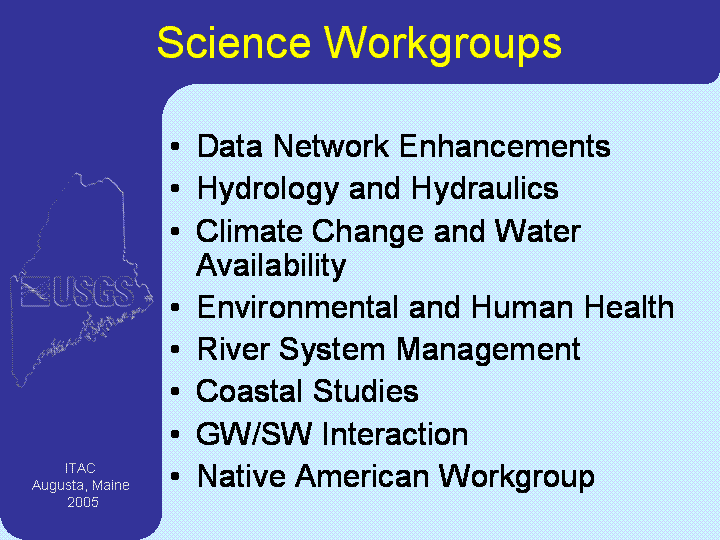
- Make good use of “Science Workgroups” for program development and maintenance.
- Maine has a number of relatively large rivers (highly controlled with dams), Penobscot River being one of them. Precipitation is about 45 inches per year.
|
| 8:45 am |
Maine Water
Science Center IT Overview
Presented by: Joel Dudley, IT Specialist, ME DO
Expected Outcomes: Information exchange.
[Reference PowerPoint presentation.]
Some points of interest :
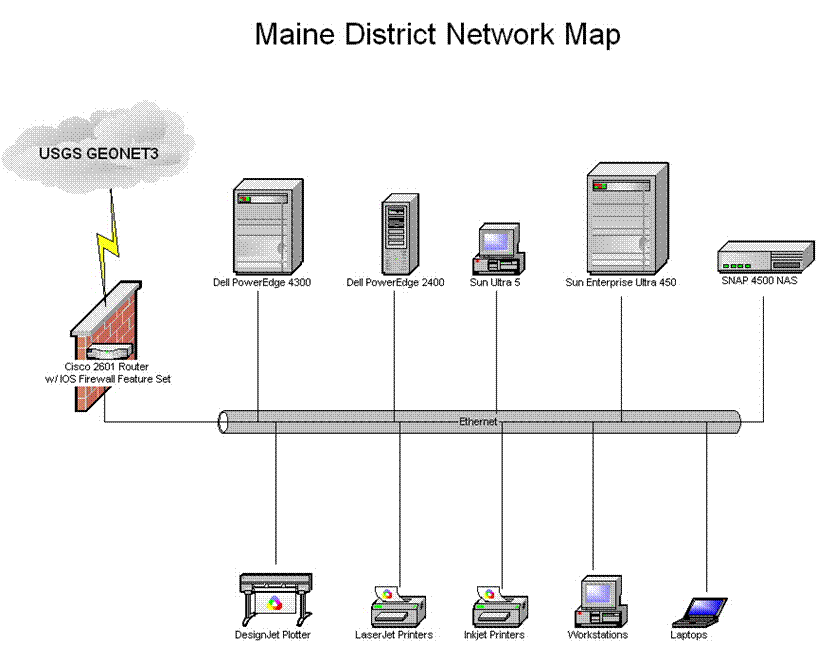
[LAN overview slide.]
- Joel will upgrade whole network.
- Two redundant T1 connections: Reston & Northborough , Mass.
- Totally converted to AD.
- Still have Sun Ultra 5 (for some functions).
- WSC has 6 networked printers; 28 /WinXP desktops; 9 WinXP laptops; 10 PDAs.
- Recent updates: removed trusted NT4 domain controller; upgraded to Windows Server 2003 as a DC.
- Backups (Windows): Full data ones Friday nights; full data (differential) backups done Mon-Thursdays.
- PPP (Proposals, Projects, and Publications Management System) – Created by Robert Dudley – Management Database has following features:
- tracks funding or projects, and pubs associated with them, and where they are in review process;
- establishes proposal codes;
- contains full proposal and summary and generates cover sheets for each project proposal;
- contains internal fact sheets, containing funding information;
- contains external fact sheets; and
- associates everything by project code.
Maine WSC has been using it for 2-3 years. New version expected in October. Pubs part updated by Glenn Hodgkins (Reports Specialist) on a “real-time” basis.
Discussion: MN WSC also has something they use to track reports and project QA steps. Perhaps all these systems should be coordinated. Stephen King wants to have a way of tracking reports through the review process. Katherine Lins suggested to Stephen King that he first look into WRD’s official Reports Tracking System.
- Joel wrote a function called USGSRound Excel Add-In (for discharge measurements), for rounding numbers. Discussion on rounding function followed.
- PDA Software Development Plan (by Robert Dudley) – Nothing with water quality yet, but used extensively for SW; ice measurement; GW; precipitation and snow surveys – posted on Maine WSC Web page; people from outside really like it. Not all conditions outside of Maine are included. Bob believes he e-mailed information about it to all Data Section Chiefs and SW specialists. Discussion on this followed. User documentation needs to be written for program.
- Real-time temperature map: Was #1 hit Web page; it draws people. Generates much attention to USGS; they will be adding another nine maps this year. Gets data from DCP; 4-hour or 1-hour windows. Joel makes changes. He gets delay through NatWeb (because of the AFS). Data updated every half hour. Emergency Management liked it during “deep freeze” last winter. Discussion on NatWeb followed. NatWeb can work out emergency situations. Joel has had replication errors. Data are not published. They’ve been trying to get publishing guidance from Headquarters. Weather Service is cooperator with the maintenance of this map.
- Automated current conditions report
- Real-time flood tracking charts (four periods this spring where it went above flood stage) – updated every 15 minutes. Discussion followed.
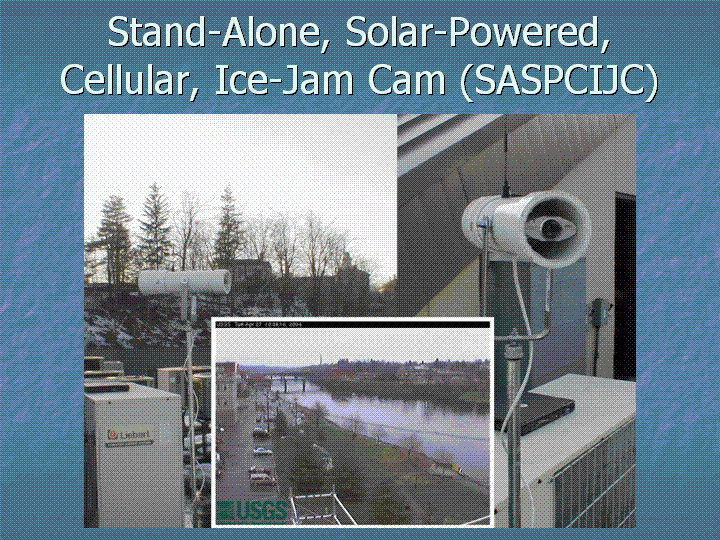
- Stand-Alone, Solar-Powered, Cellular, Ice-Jam Cam (SASPCIJC)
Delay is a real issue and concern, especially when there are ice jams. (Water behind an ice jam can rise as much as 1 foot per minute.)
Cost of setup: Hardware - ~$1,000 + $60/month data access…~$1,600, total.
ITAC comment: “Every State should have one of these.”
Additional concerns from Joel Dudley (added 8/18/05):
AFS concerns:
Ken Lanfear will talk to David Boldt and Lorna Schmid about this. There is a valid need to have instant replication.
- Norton Anti-Virus software
- There is no way to configure automatic updates. Maybe newer version (10) rectifies this.
Susan Trapanese will talk to Joel about NWIS updates (using it while cutting off AFS replication).
Qs: Presented by Joel Dudley, SA for ME WSC, from his Issues/Concerns slide:
Q: Re: ActiveDirectory: What about Domain Controllers in smaller Water Science Centers?
A: Kevin suggested talking out with Paul Exter (National AD rollout). They may have to make changes to architecture. Local DC/connectivity goes hand in hand.
Joel would like to customize his organizational unit (OU). Joel would have to take OU training, to get certified; then he can set up his own OU. Joel can be an OU administrator if he doesn’t have local DC. (Terri Moore will follow up on this for Joel.)
Q : Status of Smart Card deployment?
A : They have the readers now…no direction for them yet on how to obtain these cards. Deadline? Kevin will discuss during his presentation in the afternoon.
By 2/06, all USGS must be authenticated; it is a huge unfunded mandate, and it is a work in progress.
Q : Reorganization effects on VI/competitive sourcing?
A : There hasn’t been much transition between changing of Directors. Pat Leahy is still holding the cards. Bill Carswell presented cyber seminar to Regions through Town Hall meetings, explaining region/subregion model.
Q : Password management – Hard to know 35 passwords, as IT specialist. Will Smart Cards help this?
A : They are supposed to help. Terri Moore will address this tomorrow.
Discussion: Different password expiration dates. Why is this necessary? There are privacy issues. “You’re only as strong as your weakest system.” Can’t get around it. We need to pass on the information from Roy McCullough and Ellen Rierson on password management issue.
Terri Moore will write something on this issue and distribute to ITAC members.
|
| 9:30 am |
BREAK |
| 10:00 am |
Town Hall Meeting
Presented by: ITAC/Center Staff
-
Bureau IT Issues (30
min.) (Kevin Gallagher, Chief Technology Officer, GIO)
-
Most of ITO supports USGS infrastructure, with local support to Reston.
-
Bureau Windows Support Team and IT Communications Team – models for these teams were borrowed from Water.
-
External Drivers for USGS Info Technology (main focus of presentation)
-
Federal IT Reform (some “aside” points):
-
E Government Act – This Administration is embracing it.
-
FISMA – Passed after 9-11; deals with Security requirements
-
FY04 Budget Cuts
-
$100M spent on IT
-
Flood of IT initiatives coming from DOI. Laws will be enforced through budget cuts, backing OMB decisions.
-
DOI didn’t see agencies adopting reforms, and many were not following investment strategies; so budget cuts resulted. (NWIS is an example of a program that has adopted IT reforms and investment strategies.)
- DOI Secretarial Order – All bureaus develop an IT Capital Planning Process.
Q: Will USGS obtain money back (from OMB cuts related to IT) if we do follow initiatives?
A: Not anticipated. We’re getting unfunded mandates. For example, disaster management (disaster.gov) – common alert protocol. No funds to do it; have to use existing budgets.
Q: Any of this in the field?
A: IT ones: OAS investments
We need to look into business case. Investment Review Board looks at projects for redundancy (i.e. pubs tracking).
National Reports Tracking Systems meet some needs, but not all. Makes sense to homogenize some functions…but not all of them. Review Board has to, at some points, “let science do science.”
Staff comment: It’s frustrating trying to do science, while trying to coordinate IT activities.
Q: Is Safety training online effective?
A: For a few offices, it was a step forward toward learning safety training.
Discussion: It’s critical we act as a single agency, yet we need to integrate with this parallel process.
Chief, ITO: “Water is great for offering Enterprise solutions.”
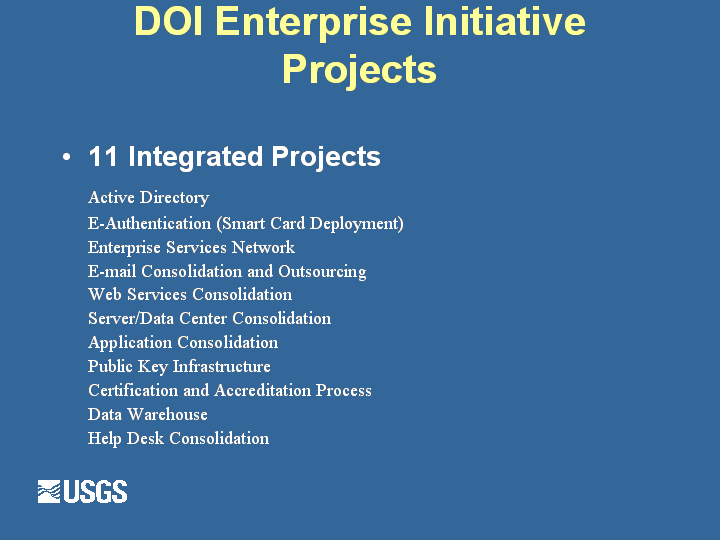
DOI Enterprise Initiative Projects (11 integrated projects):
Active Directory – ongoing
By late FY06 – E-mail consolidation and outsourcing
DOI CIO Directives
How is ITO responding to these drivers? Trying to improve communications, through IT Update that is sent out via e-mail. ITO Informant is sent out via All Employee Bulletin Board.
Q: Do we see line-item funding for IT activities in Headquarters?
A: OWI funded from line-item programs. No kind of overhead for these programs. Reorganization has changed a lot. Functions were lost by OWI; more “generalized” now at Bureau. Event so, all the money is program money.
Discussion: Basically, we’re doing a lot more functions at the field level. It’s hard to understand the system now; it’s confusing. Discipline Offices are barely scraping along. The Maine WSC doesn’t even have specialists anymore.
Q: Have decisions on ongoing reorganization “passed Katherine by”? Between the GIO and OWI?
A: For the latest round of reorganization decisions we don’t have much chance for being “at the table.” NWIS is still protected as a Water system.
Discussion: The ITO has no intention on taking anything from anyone. GIO was looking for “crosscutting things.” Kevin Gallagher has been our advocate, regarding the interest of some Water programs.
Also some drivers from outside USGS that we have to address in OWI. Example: NWIS & STORET: OMB is asking, “Why use both systems?” Have to come up with a solution. Kevin said that OMB has come out with a list of systems, suggesting which systems should align. He sees NWIS and other systems as being very unique.
- Office of Water Information
(OWI) Update (5
min.) (Katherine Lins, Chief, OWI)
OWI holds together those IT-related things in Water that are of
national scope.
- NWIS Update (5 min.) (Susan Trapanese, Chief,
NWIS)
- Q&A with Science Center Staff (All)
|
| 11:30 am |
LUNCH |
| 1:10 pm |
ME Staff presentations related to IT use/functions
Handheld PCs and ADCP activities (Joel Dudley/Greg Stewart) (Web-Ex initiated)
- Equipment
- They use PDAs as laptop.
- iPAQ 2210/2216 running PocketPC2003.
- They use 128MB cards; enough for routine field downloading data.
- Off-the-Shelf Software
- Maine WSC-Developed Software
- Software Distribution Process
- Keep the last two backups (in case of emergency), but backups can only be done on same exact equipment.
- USGS Maine WSC Software
- Q-Calc (calculates and records open-water and ice-discharge measurements)
- Displayed output sheet
- Development of a national version currently underway
- Levels form (gaging stations levels form); site visit form; snow survey form
- Snow surveys done for Emergency Management
- HTML comes out of the PDA…no conversion process.
- Demonstrated PDA, loading data (State-wide) & entering in fields of Pocket Controller.
- Cost is $350 for PDA; software ~$60; etc. - ~$600, total
|
| 1:50 pm |
Field Data Entry, Handhelds Update (Burl
Goree, call-in)
NAWQA Biology TDB (Sandy Williamson)
[Reference PowerPoint presentation.]
- Gave latest updates
- Overview: More training sessions at Central Region Data Conf.; Pocket PC training; expanded SWIM to 16 beta testers; training on MONKES presentation. Latest training held in Sacramento .
Software issues:
- Monkes application is most useful for recording many levels.
- SWIM application – replicates to Oracle database; different interface. Been going on for a while now. MONKES has been very well received.
- Approach by Frank Crenshaw…someone needs to support development of PCFF.
- A particular drawback is that it uses Visual Basics.net. Microsoft no longer supports this.
Hardware issues:
- Districts continue to buy “ruggedized” versions of Pocket PCs.
- Need to give people options.
PDA – ruggedized version (TDS Recon - $1200) – Demonstrated by Sandy – Nice device
- New Otter Box ($100.00); includes stylus
- TDS – more durable – Comes with great battery; about a month of power
- Backup of older versions? Provided you’re using same PocketPC version, then you can.
- Older Recon screen easier to read in bright sunlight.
- Advantages to having HIFprovide these. Burl thinks there are a lot of benefits to this; we need to consider it.
Discussion: HIF approached Burl. Would be attractive feature to pre-install software. Would WSCs be willing to add another few hundred bucks to get it already loaded (i.e. $1,350 vs. $1,200)? This is for the TDS Recon (no Bluetooth; there is a model for it though, and you can install it); more expensive, but less fussing. Can do same things with $600 model. There are about 30 out there in the WSCs now (17 in PA WSC alone). Rental program viable, economically? Range issues? Burl not sure about the ranges. Maine WSC has problems with “reaching” range with Bluetooth and StreamPro. Burl offered to help Greg Stewart with this problem. Solution may be cards. Possible solutions to this problem were discussed.
Q: Re: PCFF—Anyone else have experience where they’ve lost an entire field-trip worth of data in PCFF?
A: Burl suggested that Jeff contact Frank Crenshaw about this. It also would be great if PCFF could directly link into NWQL LIMS.
Discussion: We have the prototype…Burl can provide answers to Committee about the number of users and how they’re using PCFF. About one to three people use it in each WSC, except Colorado , which has more users. Burl will send the questionnaire results to Katherine Lins and Sandy Williamson to discuss with OWQ.
 Aug2005.ME.1 – Katherine Lins will work with Sandy Williamson (NAWQA representative) to talk with Water Quality about the issue of moving forward with PCFF. Aug2005.ME.1 – Katherine Lins will work with Sandy Williamson (NAWQA representative) to talk with Water Quality about the issue of moving forward with PCFF.
Joel Dudley finished his presentation on handheld PCs.
- Level notes
- Joel makes an HTML file.
Q: Are there groups of users who are more comfortable with the smaller screen as compared to seeing an entire form for recording filed data?
Discussion: Sandy only found one device with large screen; 640 x 480 one emulates old one…Isn’t there a bigger market out there for this? We have around 50 fields to enter…can be difficult with small screen. PDA screen has the same info and size as larger screen…just can’t see all at once. Our data collection is more complicated than the average. It takes training to get used to it.
Discussion: You have to change people’s work styles to go with more efficient product.
Is there a benefit of HIF stocking Recons? If bought through them, you’re sending money outside the District; why not buy it from open market? Greg Stewart recommends giving it to people to test. He sees ruggedized ones as “ancient”…too old. Several ruggedized Pocket PCs are coming out with current operating systems. Many districts don’t have level of IT support for field acquisition of data as in Maine .
Sandy demonstrated handwriting recognition of PC.
|
| 3:04 pm |
BREAK |
| 3:20 pm |
Map Interface to NWIS Status/Update
Presented by: Gary Latzke
Expected Outcome: Update
Gary now has the lead for the NWIS mapping.
Goal: to be intuitive and simple; only accessible w/in NWISWeb. It’s on Apache Web server: sys19capp.er.ugsgs.gov: NWIS – Launch Map Viewer
NWIS data sets have about 1.5M sites; sw, gw, and meteorological sites.
Six tools located at the top of the Web page.
“Locate tab” – by State, County, or Zip Code.
Map layers tab gives option of sw sites, gw sites, meteorological sites. |
| 4:00 pm |
Status Report on SmartCard Implementation
Presented by: Kevin Gallagher; Paul Exter (call-in)
Expected Outcome: Field reality discussionha
[Reference PowerPoint presentation.]
Homeland Security Presidential Directive 12
Authentication issue – This presentation was prepared for Executive Leadership Team.
Federal Information Processing Standards (FIPS) is standard now.
Policy for a common identification standard for Federal employees and contractors ( August 27, 2004 ) says it all.
- Part I Compliant by Oct. 2005 – Need process in place for new employees; includes background investigations.
Common Interoperability Requirements
- PIV Part II - Physical access control systems – place in by FY08
- By Oct. 2006 – We have to have processes in place for places in PIV Part II.
DOI centralized badging process
- National Business Center (NBC) will print & personalize all badges.
- Projected cost - $125 per badge.
- It’ll be ~$125/card per person – physical cost + certificates.
Scope: Federal employees and contractors who need access to controlled facilities
- Draft OMB Guidance
- Personnel infrastructure requires separation of duties; person who makes card cannot hand card over, for example.
- Facilities to convert to Smart Cards by FY08.
- Cards will be your credential – more of who you are; there will be more info on it than ID badge. (It changes the way the Government credentials its employees.)
- There will be all new card reader installations at new facilities.
- The model is for all large Federal buildings.
- Oct. 2006 – employees – new ones – will need smart card; existing employees will need by the following year.
Logical Access – DOI is nowhere near setting this up yet. Discussion : Lori Penn, USGS HR, and Linda Walker, Facilities, USGS – They are fighting the fight for smaller facilities (such as many WSCs) on this.
Good example where technology is making us more complicated…coming from OMB.
|
| 4:40 pm |
SLEDS to NWIS Update
Status on OSW Contract for Graphical Rating Tool for SW Records
Presented by: Sandy Williamson, Steve Blanchard (call-in, from Alabama)
Expected Outcomes: Information exchange.
Several districts are using it: Need to have some kind of protocol; will be done mainly through Phoenix group and SLUG.
Sediment Lab Analytical Request form – SLAR is working.
- Sandy clarified. Method of Collection - didn’t want SLEDS to upload method; would overwrite what was on form. Have to clarify what data will come back on SLAR form. Setting policy between OWQ and OSW; it has never been a national thing. Trying to get more data to NWIS. SLEDS programmers did what they were supposed to do. Transition to NWIS will not happen overnight.
Discussion: Not a trivial process….getting a group together that represents different viewpoints and approaches. The mechanism is there; have to get going on the policy.
Q: Status on Precipitation Policy Memo reviewed?
A: It was sent to WRD Senior Staff 2 weeks ago. Many districts concerned about the proposed policy about serving temporary precipitation data. Data will be put on the Web for non-quality assurance sites for 30 days; then deleted from NWIS. Some Districts don’t think we should be posting non-QA’d data. Need to have discussion with Senior Staff. Will be brought before Senior Staff, 3rd week in October.
- Graphical writing tool: HYDSTRA – through a CRADA we worked with them to develop software that meets USGS needs for producing streamflow records. Spent over a year working with them. Takes data from NWIS. Pilot showed significant savings—at least 8 hours per record. Went out to bid and AquaInformatics (a Canadian company) won the bid to provide a good graphical user interface. They have 6 months to modify their software to our specifications – 40 pages that SW user group developed. Dec. 1 – We have a month to test it; if acceptable, we pay for it; if not, we don’t pay.
Discussion: It will be a great savings in records. HYDSTRA didn’t meet the bid… AquaInformatics’ product will be similar to HYDSTRA. Team, including Joel Neilsen, will help review this. If accepted by 1/1/06 or later, could begin process of training. Company is very proactive and wants to develop prototype(s). Cost of contract: ~$150,000; maintenance only ~$20-30K/year. HYDSTRA bought out by Kisters – a German company (no longer doing software). People who wanted HYDSTRA will get it for free. Maybe we should show the Canadians PCFF. Maybe they can do this for less. It would keep prices down for future work.
Q: Will XML interface be integrated with new version?
A: Susan: Need interface with NWIS. Scott Bartholoma is busy writing this. It’ll be ready at same time as software.
Q: Will we own the source code?
A: Steve : We will not. We didn’t ask for source code, only to be made available in escrow account. This approach was chosen to contain pricing.
Q: Will there be any kind of price fixing?
A: We have a 5-year contract, which is very reasonable.
Sandy Williamson will be in touch with Steve…about getting other contracts for similar needs..
Continued with Gary Latzke’s presentation on map interface to NWIS status/update (5:07 p.m.)
NWIS screen displayed.
- Working on getting cartography looking nicer.
- Can convert; it was suggested to put more scale-type info onto map. Is dependent on the cartographic projection used. Gary is expecting they will end up projecting it. System will run a bit slower then. If speed is an important factor, then decisions can be made. Right now, it’s pretty fine-tuned to speed. It’s better to modify based on user input.
- Can look for sites by selecting from four attributes.
- Put tool over top of site, will get hyperlink to NWIS homepage.
- Once done, will send out for internal USGS assessment.
- Katherine Lins would like to release something to USGS by end of this FY. Need to have Cartography work on this—people who have a good sense of design.
Q: Planning layers?
A: No. They’re trying to keep it simple.
Q: Incorporated into NWISWeb?
A: Can access it within NWISWeb. Original intent was to have an interface outside of NWISWeb. Additional functions can be added on later.
|
| 5:25 pm |
Adjourn |
| Wednesday, August 17, 2005 |
| Time |
Agenda Item, Presenter(s), & Expected
Outcome |
| 8:00 am |
Eastern Region IT: Status of IT Activities Related to Support
or Issues for WRD
Presented by: Stephen King
Expected Outcome: Information Exchange
[Link to PowerPoint Presentation.]
Updates from Regional perspective – Upgrade of operations
- Needs help with C&A
- Need to manage IT operations at Regional level (ER) – Operations now include the Powell Bldg.
- Scope: ITSO (Information Technology and Security Office)
- Right now, Security Operations team is at national level
(http://itsot.usgs.gov/overview.html)
- Computer Infrastructure (Notes & Bureau Windows Team)
- Other science centers – largely Geology (programs offices)
- National Center Services supports the National Center.
Q: Advisory Board for Contact/Call Center – status?
A: Kevin thought he saw a charter…
Kevin or Steve will check on status of charter for Advisory Board for Call Center .
Capital Planning and Investment Control (CPIC) – Steve working on Regional CPIC.
- Moving into a project management approach.
Benefits to Region:
- Improve customer support – Steve will hold people accountable.
- Implement consistencies among Regions by regular communication and each Region attempts not to get ahead of each other.
- Vulnerability Assessment & Management
- Plan of Action & Milestones (POA&M)
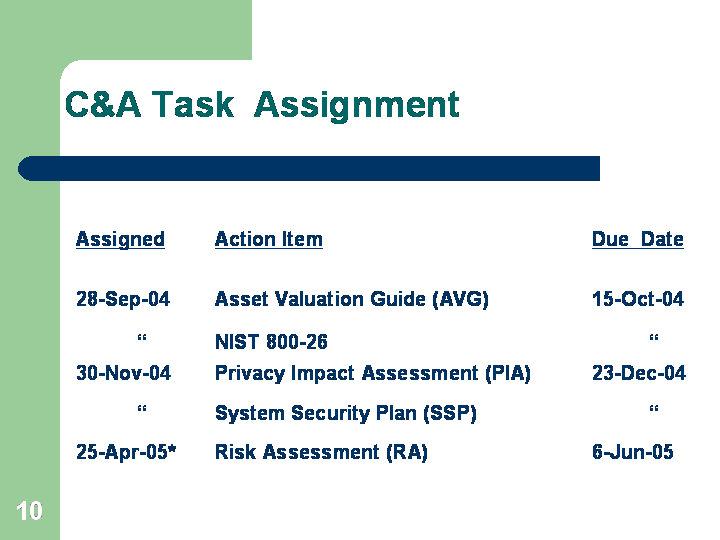
- C&A Task Assignment
- Steve needs help with this.
- REXs encouraged to move C&A forward. [Assignment Dates]
- Regional CTOs talking together; Jessie Alvarez is ER CTO. She makes sure all is understandable before it goes out.
- Chart - % of completion per document for each Region (as of 6/6/05 ) –
- Chip went to training for designating approval authority (DAA). Pat Leahy had to do this instead. Had to sign off on all C&As. He was questioning all this…needed to hear the benefits of the process. He signed. C&A needs to be done; DOI is tracking all this on scorecards
Q: Cobell case pointed to lack of architecture as a major point of concern – Architect, about how to organize the various systems to ensure no access to Indian Trust Fund.
A: Had to do document USGS business case to stay on line. Because of security breaches there is concern about our FISMA score in regard to this case.
Discussion followed.
Other Noteworthy Highlights:
- Reston & Madison – scheduled to migrate to DOI AD domain before winter.
- Smart Cards at least a year away.
- ITEM plenary video available.
- NatWeb now part of Science Education and Information Office.
- New login banner(s) being reviewed by ITSSC.
- Science Education and Information Office – Includes Library, ESICs…
- Knowledge Management workshop.
- Scope of workshop will be limited to some tangible things. It’ll be worthwhile endeavor. Kevin encourages someone to attend this.
- Steve King will find out when Knowledge Management Workshop is. the week of January 24.
[Reference e-mail sent by Stephen King to ITAC about the Knowledge Management Workshop.]
Discussion : - Fair representation in ITSOC group?
- ITAC members asked. New group…Most don’t even know group exists. It’ll be considering Bureauwide security issues.
- Communication could be better…especially with NWIS. They tend to get info from the bottom up.
- Steve will take this info to Janet Holland.
- Could have a rotating ITAC rep in group – a field rep…to make sure our interests are represented.
|
| 8:30 am |
C&A IT Security Questionnaires (WSC experiences, training)
Presented by: ITAC
Expected Outcome: Discussion and possible recommendations
[Reference Jeff’s e-mail forwarded from the northeastern WSCs to ITAC.]
Discussion: Terri – Training offered too late…after process started. SAs need the training. Should have Senior Management/Executive training.
- Rumor from Denver training session mentioned 1 FTE needed – to handle all the steps to complete C&A per system, NWQL experience.
- Gary Neverdon, C&A Manager, has been providing training to Cost Center Chiefs via cyber seminars last winter (2005). (Several ITAC members guessed that WSC Directors did not pick up on importance of attending this seminar.)
Still slow in getting response. Hired field team to create templates and instructional documentation on how to fill out documents. Have most guidelines posted onto Web site now; to help them go through what’s required. Heard direct supervisors not helping out…SAs doing; supervisors should be doing it, with SA input. Hired contractor to train on document creation itself. Going through “how to create a contingency plan”; risk assessment – What are the risks threatening your location? Has been a learning experience.
Schedule of training events – Denver , next week; Menlo Park 9/12; Reston – 10/24; Boise – sometime in February. On Web page; will send URL to ITAC.
Q: How is information presented? A Center Director needs to know what is expected of their staff. Suggests going through the REX instead, not through IT staff. In ER, they brief the REXs.
A: It goes to CTO; then to their own points of contact.
Discussion: Takes a lot of human resources. Working on risk assessment now. More than a “paperwork drill.” There is a template that must be used; doing it properly, can lead to benefits, such as backup plans, emergencies, etc. Admittedly, it’s a huge effort.
Q: Effort level?
A: Has to be renewed every 3 years. Next time will be easier; first time is a major effort.
Discussion: Gary asked about this, for someone skilled in IT and knows how to document the C&A.
Stephen King (ER GIO) will make numbers available to ITAC (study done on amount of time it’s taking to complete C&A tasks, etc.). Five different assessments – 173 hours taking for all products needed, all C&A documentation. What takes the time is putting together info for documentation).
Training: What is the importance of attending cyber seminars?
Terri – Recent thing of updating training in computer security/C&A. Has there been Senior level training recently? Not since January…Maybe training that is not too long, less than 2 hours…
Joel – He’s trying to meet the deadlines. Have to tailor it to your own environment.
Discussion: It came in as Bureau requirement. 80% of C&As needed are NOT GIO structure – out in field. Cindy, Gary, and Linda had big learning curve to figure this out. They’ve tried real hard building templates and designing the training; hiring contractor to assist; cyber seminars; memo communication – All to prevent people feeling “uninformed.” Kevin Gallagher recognized their efforts. Jeff Stoner said training offered SAs in Denver was excellent. There has been communication, but it hasn’t been on Center Directors’ radar screens. Such announcement sent through REXs (supervisor) might achieve better attention.
Aug2005.ME.2 – Katherine Lins will talk with Kevin Gallagher to see that C&A training announcements go out to Senior Management. Jim Nicholas will follow up on distribution of announcement about critical need to accomplish C&A with buy-in from WSC Directors; it can include training announcements from Gary Neverdon. (Reference e-mail Gary sent to ITAC on 8/17/05.) Stephen King will make numbers available to ITAC about the assessment study that was done on amount of time it has been taking to complete C&A tasks, etc. |
| 9:15 am |
Update on password management
Presented by: Terri Moore; Ellen Rierson and Roy McCullough (call-ins)
Expected Outcome: Information/discussion
In April 2005, ITAC sent a letter to the BITSM office requesting assistance with password management. Issues addressed were the inconsistencies of password expiration cycles, lack of information on tools available for password management, and a central location on the Web for password guidelines.
- On Aug 17, Ellen Rierson, IT Security Manager, Hdqtrs GIO Office, and Roy McCullough, Information Security Team, Hdqtrs GIO, participated by telephone, to report status of ITAC’s request during our Maine ITAC meeting. The following issues were discussed:
- Q: One of the main concerns was why the National Business Center (NBC) system, Quicktime/TNA, password expiration date has been set to a more restrictive time than the DOI requirement of every 90 days. Quicktime passwords have been set to expire in 60 days. Can the Quicktime password requirement be set to 90 days?
A: Password expiration dates are set by the owner of each system. The DOI requirements are only the minimum requirements. It is the system owner’s decision if they feel they need to set a higher standard to protect the data on their systems. Therefore, we cannot force a system owner to change their password management. The system owners are the individuals that have to feel comfortable with the risk level that is associated with password management. (Note—While NBC is part of DOI, we have little control over it.)
- Q: What tools are available for password management? How can we assist our users with password management?
A: Keepass has been encouraged for password management. A copy of the KeePass software can be found at the Bureau Windows Technical Support Team (BWTST) Web page at http://bwtst.usgs.gov/security/keepass/index.htm. In addition, Roy briefed the team on several other tools that can be used. While not formally reviewed within USGS, the Pass2Go (RoboForm Portable) from Siber Systems, Inc. looks very promising. USB flash memory drives could be used. If USB flash drives are used, make sure that passwords stored on these devices are encrypted. This could be done by several different methods. Some flash memory drives (Kanguru) contain an encrypting / decrypting chip that provides easy encryption and decryption (with a pass phrase) of data. Also, a product such as PGP (Pretty Good Privacy) could be used to encrypt password data on the drive.
- Q: Can the BITSM office create a Web site with information relating to password management, how to create a good password, and where to find password instructions for the various systems we use?
A: Roy has been developing a new Web site with a listing of the major systems that we use. In addition, Roy will be adding hyperlinks by each system identified to direct users to the Web page that will provide them information on how to reset passwords for that particular system. The Web site will include information on how to set good passwords, where to find instructions on resetting passwords, and recommendations for tools to manage passwords. The Web site is constantly being updated and Roy welcomes comments: http://internal.usgs.gov/gio/security/password_management.html
- The latest change was the need to implement password and screen locks on Blackberry devices. Although the group agreed this was a nuisance, the bottom line is, it will prevent somebody from picking up an individual’s Blackberry and accessing e-mail and any other additional information stored on the device. The software upgrade also provides the Lotus Team the ability to remotely wipe the Blackberry clean if it is lost or stolen. Terri inquired if the password requirement was mandatory and if we can remove the screen lock portion. Patty Damon confirmed that the password requirement could not be changed. It will need to be changed every 90 days. Patty agreed to investigate if there was a way to disable the screen lock. Patty later determined that the screen lock can only be extended to 1 hour and cannot be disabled. Patty also agreed to contact RIM to see if they can make any modifications to the software to disable the screen lock. Instructions have been sent out to all Blackberry users on how to extend the screen lock and how to change a password.
- Kevin Gallagher briefed the team on why emphasis has been placed on password management. One of the issues that we need to address is the use of the same password on multiple systems. If the password is cracked, on a less secure system, it would result in the hacker gaining access to other systems with greater sensitivity and need for security. The USGS has been audited 6 times through penetration testing. A report was produced identifying 203 findings of vulnerabilities. We were rated moderate, then high risk. The IG office has a tool that can determine if individuals are using the same passwords for multiple systems. The GIO currently doesn’t have a tool that can test this vulnerability, but is in the process of developing a similar tool. Kevin felt we need this tool so we can be proactive and find vulnerabilities.
- Kevin’s information gave the ITAC a better understanding on why we need to enforce the password rules in the Survey. Although everyone agreed password management is becoming increasingly more and more onerous, complex, and time-consuming, we understood the need to protect our data and sensitive information maintained on our systems.
Aug2005.ME.3 – Terri Moore will follow up with Roy McCullough and Ellen Rierson regarding adding links to the password management Web page. Roy will also research tools that can be used to generate passwords and add to the Web page.
|
| 9:50 am |
IT Issues Pending from DOI... Any Prognosis That
Could Affect WRD?
Presented by: Kevin Gallagher
Expected Outcome: Information/discussion
ESC funding issue:
Dept. has provided new money; earmarked for centralized billing. Enterprise Security Network (ESN) – trying to consolidate networks; reducing places on Internet; consolidating trunks. DOI will only be buying one network. Good thing: 24x7 monitoring (from Security Co. in Herndon).
Historically, worried about the funding.
- Cost of entire 24x7 operation: Considered shared infrastructure. DOI will pay into each bureau’s budgets to foot this bill.
- Doesn’t anticipate any major funding issues.
- Issue still has to be addressed: Pay less, or get more bandwidth? Kevin suspects the latter.
Desktop contract: Recompeting contracts now. Paul Exter sent a presentation. Printers and peripherals added to contract. Hoping for not a major change in vendors.
Discussion: Great if we could use rebates; reapply to cards. Contracts not always a good deal, esp. if they last very long. Recompete expires in September. Timing is not compatible for year-end procurement. Kevin will ask Paul Exter a question: Different vendor? Will they be ready?
Aug2005.ME.4 – Terri Moore will follow up with Kevin Gallagher regarding either extending the current desktop/laptop contract for rest of FY05, or the possibility of obtaining an end-of-year buying waiver to get us through closeout. The concern is the current contract expires on 9/1/05 and the new contract takes effect the same day. We need acquisition procedures put in place immediately for end-of-year purchasing. Jeff Stoner , ITAC Chair, will communicate ITAC’s collective input: Bulk buys work for desktops—not for laptops. Sandy Williamson will draft ITAC’s e-mail on this issue.
- Cobell Case – 59 days of testimonies
Thought we’d get drawn into case to testify.
Any day now, the judge will rule on this (w/in next month, possibly).
Can order another Internet shutdown – ALL bureaus.
- Could be a certain amount of time to comply.
- Old content would be delivered through Web. Intranet would still be there. Message would have to be put onto Internet homepages about shutdown. Wouldn’t hurt to start thinking about this.
- Could order shutdown of only Trust systems.
- Could order Trust systems to shut down until they are put on separate network. (Kevin hopes it is this.)
- Messaging – Coming down the road.
Aug2005.ME.5 – Katherine Lins will talk to Kevin Gallagher to prepare e-mail to go out to WSCs about the impacts of Cobell case. Need to give heads up to WSC Directors, who will copy SAs, about possibility of shutdown of USGS Internet, as a result of the case.
Q: What about Outlook?
A: Initially, just e-mail.
Will need to recompete because of bundling attempt by bidders. |
| 10:20 am |
BREAK |
| 10:30 am |
Advances in Cell phone/GPS/Camera technology and WRD applications
Presented by: Sandy Williamson
Expected Outcome: Heads-up information
[Reference PowerPoint presentation.]
- Way to store digital photos? WSC of MN is beta testing software for archiving/managing USGS digital photos. Sandy will talk with him. This is a huge issue for documenting field work.
Discussion: You would think digital cameras would want to provide GPS technology. It’s getting better; on front end now. Future database for digital photos – not a trivial issue! Storing links, or photos? (Makes sense to store photos, but avoid storing in multiple locations…what kind of resolution – many issues.)
|
| 10:45 am |
Issue Clarification of 24x7 Coverage
Presented by: Katherine Lins, Scott McEwen (call-in)
Expected Outcome: Information exchange
[Reference Elaine Stout's e-mail to Scott McEwen from 8/12/05.]
Kevin will focus money toward better modeling for 24x7. He’ll forward information (white paper) to ITAC and get feedback. By mid-Sept ( 9/15/05 ), hope to have phone at HelpDesk answering 24x7, live person. Group of people would be on call…We’ll see in the white paper.
Aug2005.ME.6 – ITAC members will review Kevin Gallagher’s draft of white paper for procedures for 24x7 network support. Comments will go to Brian Reece who will compile results. (Reference: Kevin’s e-mail of this very rough draft for ITAC review on 8/17/05.) Deadline to review: in 3 weeks; ITAC comments to Brian by 9/2/05.
Network Operations and Security Center (NOSC)
Goal: Have 24x7 service operating for all. Over next few years, Kevin wants to enhance what they do; focused monitoring on real-time servers. For now, want to get basic 24x7 coverage.
|
| 10:55 am |
Update on Annual Data Report
Presented by: Donna Schiffer, Brian Reece
Expected Outcome: Information Exchange
[Reference PowerPoint Presentation.]
Future of Annual Data Report
(Brian presented.)
Was no consistency. Some WSCs didn’t want to publish WQ data. Some said they just didn’t have the time…some even questioned why have it? Too much effort…
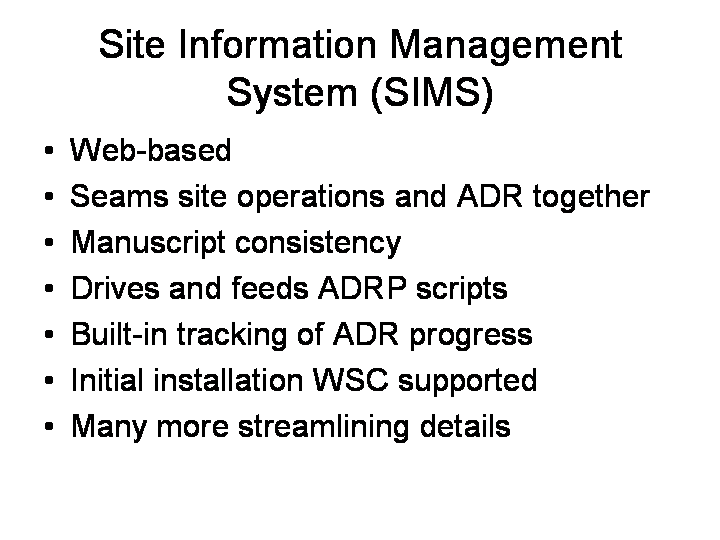
Solutions: Standardize, update processing scripts; incorporate ADR process into nationwide Site Information Management System (SIMS); display Site Data Sheet in maps, not volumes.
Scripts – automate process; 508-compliant output; moved from Word to XML (no more FrameMaker); pub standards back into ADR; Metadata carried along – documents progress; [clumsy configuration; more chance for error with scripts…]
SIMS is Web-based; manuscript consistency; built-in tracking of ADR progress; initial installation is WSC supported.
Think of files as elements, not a document.
Bridging gap between what NWIS has capability of doing and this database: National Repository/Map Interface.
Progress: Scripts are functional. Very powerful…Can put into Word document for cooperator(s).
5 WSCs prototype now (TX,NV,NM,CA,GA).
Meeting in Austin , 8/29-30/05.
Gave Demo on Web (SIMS)
Issues:
- Avoid unnecessary customizations.
- Discipline manuscripts to executive summary.
- GW/CSG sites – don’t traditionally have manuscript (but fit paradigm).
- Team needs MS Word expertise.
- Tim Stamey retires in December 2005.
- Continued national funding? (Would be good at minimal level, at least.)
Q: Management of Data: Management QA reason for doing everything annually.
Q: Still FY? A: Yes, Water Year coincides with FY.
Q: Flexibility, as far as when data is sent?
A: Yes, if you’re done collecting it, can send it. It’ll work both ways.
Q: Can 2006 water data be put into 2005 report?
A: Volume goes away; but online reference…can republish them. Two more years to get all reports into this system.
NOVAC publication? It’s the “candystripe” book. There is talk of rewriting it…but it’s just rules now.
Q: What about hydrologic conditions section? Separate publication? Guidelines for this section?
A: SAR will announce that this is done. Greg Stewart (Maine WSC) doesn’t want to lose this.
Q: Web site where committee is providing updates?
A: Tim Stamey updates it. We need to get word out.
[Annual Data Report Project Team Web site] |
| 11:30 am |
Infrastructure for Dynamic Web Page Capability Compared to NatWeb
Presented by: Chris Leeth (call-in)
Expected Outcome: Information exchange
[Reference Chris’s Word doc.]
Php – Chris spoke with a lot of people who use it.
Chris discussed his document (to see what people are doing) – from 10 sites, but he has more. Total count, 17 or 19 – individuals he spoke with.
In GA WSC, they see Dynamic Web pages is way of building program, maintaining program and keeping program.
Cold Fusion (CF) may not be end all/be all, but we need a long-term strategy to capitalize on these tools.
Q: Is it Time to put together a team to see if CF is an option to use as tool?
A: Ken talked about technical reference model.
David Boldt said that CF has popped to the top of his calls on this. CF is just as good as PHP in some peoples’ opinions.
Kevin: Should start with requirements and work from there.
Steve – Saw great products come out of CF. Have to think through, and present as a Bureau tool, not just Water.
Aug2005.ME.7 – Katherine Lins and Kevin Gallagher will talk with Karen Klima about creating a team researching ColdFusion. Kevin can decide who will lead it, etc.
User requirements? That will help Kevin, for business case.
Chris had a white paper that he had put together and sent to ITAC. Updates? Not really. Main point, the field needs some guidance. Dynamic Web pages are coming. People will use reverse proxy if we don’t give it to them. Would be nice if there was a consensus on this.
Would Chris volunteer for team? Yes. |
| 12:00 pm |
WebEx Value from User Perspectives
Presented by: Sandy Williamson
Expected Outcome: Information exchange
[Reference PowerPoint presentation.]
Sandy only got one e-mail this week about WebEx. Not foolproof. Compared to previous solutions, problems less frequent and symptomatic. Help on this has improved; problems are resolved quickly.
Has increased in use first 2-3 months, then leveled off; ~ 30 meetings/month + small ones.
It’s been reliable.
Water is 2/3 of the usage, as host.
Q: Compare with other systems…One refresh quicker?
A: For large meeting, WebEx performs better.
Comments: Sametime used in VI presentation for Managers had problems showing visuals. At VI Town Hall meeting, host had to wait forever for slides to refresh.
Should not need more than 50 seats per WebEx session, but can request more than 50 seats for a price. Valerie Walker co-presented with Sandy at ITEM. Both mentioned that if you already use Sametime and it works, stick with it. Larger group should use WebEx. That was message from both presenters.
MN WSC has learned that with frequent WebEx version updates and limited user rights, the IT folks will test WebEx before the actual meeting. This has proven to be good policy for efficient WebEx meetings.
Sandy down to minutes a week to support WebEx.
WebEx site is helpful, as well as the 10-minute online video. |
| 12:20 pm |
Update on Design of USGS Home Web Page
Presented by: Ken Lanfear
Expected Outcome: Information exchange
[Refer to Web site: www.usgs.gov/]
Some personnel changes; Nancy Spriggs left (was in charge of public page).
Office of Communications is in charge of content.
Web Advisory Group – Pixie Hamilton on this; they advise Enterprise Web.
Good Web pages – Explanation of Enterprise Web (GIO site).
Try internal.usgs.gov/webguide .
Google may be used for search engine…down the line.
Hirsch has been pushing what “our face” should look like. They feel like it should look like USGS newspaper.
Comments:
Four major disciplines should be in big letters. No rules among WSCs in same State.
- Ken rescanned all WSC home pages; more are changing to WSC from District.
- Almost all have bibliographic listings, even with Publications Warehouse. All should be in that database now.
- Chris – GA WSC does this because cooperator wants a polished listing.
- Should be able to get complete bibliography of an author from Pubs Warehouse.
- GA WSC makes aggressive use of Web site to promote program.
- Rules are: Content of Web page responsibility of WSC; anything referring interpretive info, goes through approval process. (HTML content responsibility – WSC).
- Refer to www.cyclingnews.com :
- Best managed content Ken has seen. All links work! Cross link articles too. Use “Content Management: System” maybe pay less for maintenance than we are. It treats each picture as an object. Moves whole object into structure and page is formed.
|
| 1:00 pm |
Lunch and Field Demonstration of Data Retrieval
Presented by: Stewart, Data section |
| 4:30 pm |
Adjourn |
| Thursday, August
18, 2005 |
| Time |
Agenda Item, Presenter(s), & Expected
Outcome |
| 8:00 am |
Reviewed and Assigned Responses for Maine Science Center questions
Presented by: ITAC Members
|
| 8:30 am |
Review pending action items
Presented by: Jeff Stoner
Expected Outcome: Documentation
Reference Outstanding Action Items
|
| 9:00 am |
ITAC Membership and Role Changes by January 2006
Presented by: ITAC Members
[It was noted that several end-term dates were incorrect on ITAC Web site. ITAC Members should review and let Marilyn know the correct term dates (“December, YYYY”.]
Jeff Stoner (a WSC Director rep.) rotates out the end of the year. Sandy recommended extending Jeff’s term through 2006…not necessarily as Chair. ITAC members want him to continue as a member, as a Director representative. Jeff humbly thanked endorsement, but will consider this suggestion by next meeting.
Chris Leeth – His term is through December 2007.
Jeff will check with NWQL Chief to ask about NWQL representative.
Margaret Bunch scheduled to attend the next meeting, then rotate off ITAC. Do we still need an SA representative? ITAC agreed unanimously! Jeff will discuss with Bill Carswell for Central Region nomination.
Sandy Williamson will stay on through December 2006. Curtis Price is interested in the position, but his boss may say “no.” We have a year to resolve this.
Sonja Sebree will stay on through December 2006, when we will revisit it. It should be “World Wide Web/GIS” representative, and individual should have some CF experience.
AO rep? Jeff Stoner and Jim Nicholas will look into this. Should be changed from “Permanent” to “December 2006” on Web site.
|
| 9:30 am |
BLOGs and RSS as Potential Tools for Better Communications
Presented by: Sandy Williamson
Expected Outcome: Heads-up Information
[Reference e-mail from Brian Reece.]
BLOGs are different way of communicating. Can create accounts through Yahoo. User enters and receives automatic e-mail responses.
Can do science and IT topics.
Should we put up own internal server for this? WIKIPEDIA discussed. Katherine agreed this should be addressed with Greg Allord: Should USGS consider this as medium for information? (Pubs Policy/Web Policy issue)
Sonja Sebree will talk to Greg Allord about this. May have to go to Enterprise Web.
Anyone can add information and edit it; might not be “accurate.” Verifying credibility and traceability is an important aspect.
Aug2005.ME.8 – Sandy Williamson will, at a future meeting, present information on how BLOGS and RSS can be used for IT communication.
Marilyn Billone presented list of questions about meeting minutes drafted to date which were answered by ITAC members.
|
| 10:00 am |
Next Meeting Location and Dates and Wrap-Up
Presented by: Jeff Stoner, Sharon Moore
Assume ITAC meets: Two to three times per year.
Terri Moore: noted that Kathy Peter, (Boise) ID WSC, has expressed interest in hosting and Bill Sexton concurred.
Terri will inquire with Peters about dates in December ( 12/5/05 first week in December) or January, (week of 1/17/06 , with Monday a holiday). If those dates do not work for Idaho , Terri will ask Kathy Peters about any other options between December and February.
|
| 10:30 am |
Adjourn |
 Agenda and Meeting Minutes