|
 Attendee
Information Attendee
Information
Following is a list of ITAC meeting attendees/invitees who attended
the meeting:
|
Brian McCallum |
Data Chief
-- Atlanta, GA |
|
Greg Allord |
Chief, CAPP
-- Madison, WI |
|
Margaret
Bunch |
Site Administrators
Rep -- Carson City, NV |
|
Joel Johnson |
Data Base
Management Systems -- Sacramento, CA |
|
Sonya Jones, Chair |
Studies
Section Chief -- Austin, TX |
Unable
to Attend |
Katherine
Lins |
Chief, OWI
-- Reston, VA |
|
Charlie
Merk |
Chief, WICAS
-- Reston, VA |
|
Jeff Stoner |
District
Chief -- MN |
(Acting Chair) |
Susan Trapanese |
Chief, NWIS
-- Reston, VA |
|
Sandy Williamson |
WRD Technical
Offices -- Tacoma, WA |
|
Marilyn
Billone |
ITAC Executive
Secretary -- Reston, VA |
|
Jim
Nicholas |
District
Chief -- MI |
|
Tim
McElhone
|
Acting,
NR Regional Computer Specialist -- Lansing Michigan
|
|
Donna
Hector-Sabin |
Administrative
Officer -- Madison, WI |
|
Scott McEwen
|
CR Regional
Computer Specialist -- Denver, CO
|
|
| Jim Bettandorff |
|
|
Here are the numbers for the Alaska ITAC meeting audio bridge. Only
5 lines have been reserved, so please be judicious in who
you invite to participate.
| Tuesday, June 22, 2004
|
| Time |
Agenda Item,
Presenter(s), & Expected Outcome |
| 8:00 am |
Welcome and
Introductions/Agenda Review
Presented by: Jeff Stoner (Acting Chair)
|
| 8:15 am |
Alaska
Science Center Overview
Presented by: Steven Frenzel, Acting Alaska Science Center Chief
Reference Overview of Alaska Science Center presentation
|
| 9:15 am |
Alaska Science Center IT Overview
Presented by: Carla Simpson (Reference Presentation)
Expected Outcomes:
- Describe your process for identifying and cataloging
all the datasets on all the servers and desktops in Alaska
- What's our plan to make all these datasets accessible?
- What's our plan to make this massive collection "searchable"?
- New AK Deputy Regional Director — Leslie Holland-Bartels
- Carla is team leader under GIO; answers to Leslie. Supporting about
215 FTEs (250 people). 11 staff members on GIO Team — 7.5 FTEs;
rest are contractors; supporting about 215 FTEs (250 people). Team
— "really great" -- They integrate philosophy of mission
statement into everyday work within constantly evolving environment.
Been integrated 3 years now (IT stuff).
- Different disciplines should be able to access each other's data;
need to get scientists to collaborate and work more as a team. Lack
of actual co-location is an issue
- Alaska Science Center Web site
|
| 9:45 am |
BREAK |
| 10:10 am |
Town Hall Meeting
Presented by: ITAC/District Staff
- Bureau IT Issues (10 min.) (Kevin Gallagher)
- Hydrotechs present.
- Kevin thanked ITAC and ASC for hosting
event
- Bureau gives direct support to USGS.
USGS network backbone (includes wireless, radio, PBX, phone
support; work cooperatively with regional GIO structure.
- E-mail; Enterprise applications;
Operational Security Team; DIS group — staff from
water now in GIO. Kevin is Karen Siderelis' Deputy CIO;
spends
much time in meetings downtown. Tries to interpret policy
coming down, and how it will influence USGS. He also tries
to influence the policy to help USGS. Wants feedback of
issues in the field so he can take it back to Washington.
He's aware of burdens put onto the field. He acknowledged
Carla's great talented team.
- Bureau gives direct support to
USGS.
- DOI was cut — total of $166M.
- 11 Integrated Projects: Includes
idea of everyone using smart cards for double authentication...
Kevin's office wrote up a budget to get funds to support
this kind of a mandate
- Q: USGS cut $12M
— through requests, can we recover that money?
A: Mostly cut Seismic Program. We got
some of that money back, but not all of it. Requirements
are met now, so money
will
eventually be restored.
- Kevin encouraged attendees to question
him on any of these topics
- Office of Water Information
(OWI) Update (5 min.) (Katherine Lins)
- OWI reports to Associate Director of Water. OWI is a conglomeration
of program offices that report to Katherine.
- International Program - $140K; $840K — Data stuff (NWIS
included & private orgs)
- EAP; Publishing Program (CAPP)
— not just reports; mapping too
- WICAS Program includes handhelds.
- NWIS Program Office - $4.5M
- Need to help other countries build their databases and
share their water data
- $8.8M in OWI (down from $10M) — Funding through
AD — NWIS and NAWQA programs
very important. IT security — important to keep this; DIS
program went to GIO program
- GIS went to Bureau level too. Bob Pierce is Program Lead.
Building an Enterprise GIS capability.
- Water is influencing the Bureau. We're "feeling out"
working across disciplines.
- NWIS Update (5 min.) (Susan Trapanese)
- New Staffing: Mark Hamill, NWISWeb Unit Chief. Jeff Christman,
SOS Unit Chief
- NWIS 4.4, passed formal User Acceptance Testing in early
June. Beta testing in late July. General release in late
August.
- Highlights: New SWUDS being released.
- Hydra functionality
enhanced so that old UV_EDIT and DV_EDIT can be removed.
- NWIS RT — Now accepting data from nonGOES telemetry using
a "depot." Susan mentioned that the CHIDER slides have good
information about communicating with NWIS; GNATS issue/bug
tracking tool should be used, but also users should utilize
the NWIS User Groups and Technical team leads.
- Q&A with District Staff
- Jeff encouraged attendees to use ITAC, a committee and
forum for field operations, to give feedback for IT policy
decisions in WRD. He directed them to ITAC Web page
- Q: Status of NWIS STORET?
A: It's ongoing.
Ken Lanfear working on this with STORET developers. Will
be using
XML. EPA is thinking more and more about having a common
access portal. They asked us to serve our water data
in STORET. EPA's Window
to My Environment has clickable
Web interface that brings you to STORETand NWIS data.
We're optimistic we're
moving
in
the
right direction.
- Issue raised: Fast connections, but slow with Hydra.
Taking away UVEDIT causes heartburn to those in the field.
Susan said it was first time she heard that this was
an issue, since other small offices are currently using
Hydra. Alaska may need to install Citrix Metaframe for
Solaris on the NWIS server for connection between user
desktop and NWIS-Hydra. (AK uses Reflection X.) check
out metaframe for Solaris (~$2,500 purchase). Susan will
make sure when distributing NWIS 4.4 installation instructions
that metaframe is mentioned.
- Concern about performance/reliability of AK network
connection and its effect on real-time data delivery.
AK was "down" during Dec. 2001 for 2 months.
NWS helped out, getting their data. It was winter, so not
much streamflow,
but still... Alaska is running behind from where they
ought to be. Intense field season. 75% of stations are
on the Web.
- Q: Will there be a DOI-wide e-mail about transitioning
to Outlook Exchange?
A: Kevin: Yes — 18-month
history with that decision. May need to mix our vending
environment. We will be last Bureau
to "convert." Network consolidation process;
AD project; affect messaging change out. Put his most
knowledgeable person (Paul Celluzzi)
on DOI staff, representing message instancing management.
[AD Design will be a single domain with multiple forests.]
- Q: Are we involving BLM with NHD?
A: No, but maybe we should be. (Greg
Allord will talk with them.)
- Q: Wireless policy? Tim Quinn — DOI
Telecommunications Manager. Wireless policy will
be covered during this meeting. Most have turned "off"
their wireless. It excludes Blue Tooth, so some are
using this. Blackberries & cell phones are acceptable.
Guidance for wireless at home? Right now, it's banned.
 June2004.AK.1
- Kevin Gallagher - "Publish waiver process
for wireless."
Will publish "old" guidance for wireless. June2004.AK.1
- Kevin Gallagher - "Publish waiver process
for wireless."
Will publish "old" guidance for wireless.
|
| 11:30 am | LUNCH |
| 12:30 pm |
Review of Pending
Action Items
Presented by: Jeff Stoner
Expected Outcome: Progress Update |
| 1:00 pm |
ITAC Discussion of Town Meeting and Issues
Presented by: ITAC Members
Expected Outcome: Ensuring District needs are covered at meeting
Discussion: Carla's
presentation was very good. Integrated science support is working but yet
integrated science. Not being co-located is a problem. There
will always be issues
as far as how we get money. The information everyone is collecting is available
to everyone else.
June2004.AK.2 - Kevin
Gallagher - Request all USGS SAs upgrade to MS Office 2003 and
Adobe CS. Assess issues associated with the upgrade. |
| 1:30 pm |
Training
- SA training recommendations (Scott McEwen, Terri Moore)
- Windows Office 2003 (Scott McEwen, Greg Allord)
- NWIS DBA training (Scott McEwen)
- S+
training (Scott McEwen)
- Terri has been asked to identify what type of training should be planned
for IT staff during IT technical reviews. She suggested addition this
to the IT Review Checklist. Many SAs and supervisors need assistance
in identifying training for the IT staff's IDP's.
- Can training be prioritized? List of 5-7 courses. RCSers will prioritize
list of courses needed and request recommendations from ITSOT, SUN
TAC, BWTST. (Terri Moore, WR; Scott, CR; Tim McElhone, ER)
- Windows Office 2003 — Streaming video will be made on how to create
Word template for creating reports before being put into InDesign. Phil
Redman, CAPP, teaches these. This will be done by August 2004. 90% of
people would not be using InDesign. Sandy suggested cutting course down
to an hour from two. One DVD and online for streaming. E-mail should
go out to everyone individually (not just via Bulletin Board).
June2004.AK.3 - Greg
Allord -
Create streaming video training material for Word 2003 for authoring template
for writing reports. Distribute to all Water employees and post to Bureau
Bulletin Board.
- NWIS Database training — No DBA (database administrator) training for
a number of years.
- Need to encourage districts to take this course at the next scheduled
date in October since it is not likely to be offered again for awhile.
(Putting on the course is an expense to NWIS that requires budgeting
or in advance.)
- The training class is held at the NTC. 2/3 of the districts have sent
attendees; 1/3 remains to be trained. 34 Districts have had NWIS DBA
training. Bob Hirsch would encourage it if we asked him to, if there
is a perceived need.
- Scott and Joel will contact Regional Computer Specialists as needed
to encourage attendance in the October class.
June2004.AK.4 - Katherine
Lins -
Will talk with Senior Staff to recommend training.
- S+ Training — 75-80% have taken this already.
Regions will pick this up. Training Sequence: Policy/software installation/templates/training
as needed, by users.
As far as Mac users... we should just go forward with what we support
(Office 2003 for PCs)
|
| 2:35 pm |
BREAK |
| 2:55 pm |
Limitations
of presenting true real-time data for hazards assessments
Presented by: Brian McCallum, Ralph Teller (by telecon)
Expected Outcome: Communication of issues
Stemmed from action item from SD meeting in October 2003. What is true
real-time data
Highlights of CPAC report from August 1998: "WRD
Real-Time Data Delivery System — Problems and Improvement Opportunities"
- Hydrologic Hazards monitoring using true real-time data is a critical
element to the USGS mission — it is listed in
Science Plans at all levels of WRD.
- Steve Blanchard, Chief, OSW — Real-time data is certainly a mission
of USGS, and he strongly supports it.
- TRUE real-time data is information that is transmitted, received, and
broadcast instantly from the site; emergency managers need the information
in a very quick manner, especially regarding hydrologic hazards.
- Inherent delay in using satellite systems; It's "near real-time."
- Four issues found in 1998 still exist to various degrees today:
- timeliness of data delivery system
- reliability of data delivery system
- availability (types of ways - ie: Web, fax, voice messages) of
data to users
- quality of data delivered
Of these four, the quality of the data delivered has had the most
progress made with the "Hirsch-a-gram" emails about spikes in data.
The reliability of the system has made progress with NWIS-RT, but nothing
yet for on-the-fly redundancy.
- Three areas recognized in 1998 for improvement were:
- Human resources (including 24x7x365 support)
- Technological resources (including redundancies in IT network)
- Financial resources (not detailed in 1998 report, but focus was
NSIP)
- Financial resources — NSIP has not been fully
implemented. It's now most likely under budget since it is now years
behind in implementation. ITAC is a good means to inform Districts of
new IT products for "pushing" data to cooperators.
|
| 3:30 pm |
NWIS and Hydrologic Support
Presented by: Tim McElhone
|
| 4:00 pm |
RCS'er District IT review
Presented by: Scott McEwen
Jessie Alvarez had taken the lead in trying to develop a standard set
of documents and procedures for doing IT reviews.
NWIS resolves issues as soon as they can, or refers them to someone else.
- NWISWeb package not current; neither location
had successfully deployed a centrally managed anti-virus solution;
backups
weren't retained more than a month, were overly redundant; or reached
capacity of existing equipment; there's no detailed equipment inventory
that includes machine name, make, model, serial number, OS type,
apps and their versions, plus date last serviced.
- They've done this three times. Miami in August.
(IT Review)
- Discussion: Can do as an enclave control
review. Can be used as part of C&A process. Same people who do
your Security Plan cannot do your ST&E(?). It would be like a self-assessment.
One IT review per Region. Jeff Stoner recommends to keep sending checklist out
ahead of time. "Keep it simple and effective in follow-through
of actions for improvements." Jim Bettandorf did about 10 of these
reviews. If we could do this on Bureau level, that would be great.
Reviewers learn quite a bit from this process too. (No actions items
on this.)
|
| 4:00 pm |
Reviewed notes - Action Items Up
to this Point |
| 4:30 pm | Adjourn for the day |
| Wednesday, June 23, 2004
|
| Time |
Agenda Item,
Presenter(s), & Expected Outcome |
| 8:00 am |
Future of the USGS Annual Data
Report
Presented by: Brian McCallum
Expected Outcome: Suggestions to Discipline Office Team
- Input from Greg Allord (CAPP, WI); Rob Baskin (UT); and Mark Landers
(GA) by telecon; Bob Mason not present
Annual Water Data Report (ADR)
- OSW takes the lead on the ADR because it's mostly streamflow data.
- Illinois Dist. Office was first to put report onto CD in 1998. Based
on Java script in HTML coding. Hard coded. No graphs of data. They now
have a clickable map. Clickable links to specific data. Need overall
pdf of document too.
- Policy — need citable, "reference-able" document
so you can document where you got your daily values from (May 2001,
Shepherdstown, WV).
- Georgia CD-Report: First one delivered in 2001. It’s Windows-operational
based. Incorporated an interface editor. They added graphical summaries,
station photos, maps, delineated drainage basins, GIS metadata, and
search functions.
- Western Region Web-Based Data Report: Specific emphasis will be a Web-based
product. Adopted 90-95 of Georgia's prodcut. Clickable pdf map; can
turn on and off layers. Reader just has to have current version of Adobe.
Eventual
goal
is regional/watershed
reports & ArcIMS.
- Utah District ArcIMS report
“
To CD, or not to CD?”:
- Subsidy for publishing books ended for 2003
report.
- Cooperators prefer CDs.
- Reduces reproduction costs from $113-15 a book to 74 cents a CD.
- With GA CD product, you don't have to use FrameMaker; can use Word.
To CD at all?
- Brian McCallum: So far, consensus is we need an annual report of our
data and tangible report for our cooperators.
- Greg Allord: It’s a historical record. (Jan. 25,
2001 – Senior
Staff meeting in Shepherdstown.) How are we going to handle
this core, national consistency? How will we deliver this as a referencable,
citable document? The overall report pdf is an answer
to this. FrameMaker is used because it satisfies compliance requirements.
CD
is just a physical media.
Bob Hirsch is very excited about getting ADR
out more quickly now. What method is best? Was a bit premature
to answer at that point.
Maybe ITAC, can endorse a nationally
consistent product, etc. CAPP cannot do anything unless all 75
volumes “move together.” All
75 books should have this national commonality.
Tension between national maintenance and “local expertise.” We
need to come out with a base model for
a national product. There will be standard elements across the board.
If looking at national and Web-based, we will need to archive
the Web page at a given point in time. (A CD is not
an archive media—it’s
a tangible deliverable (i.e. handed
out at conferences, etc.).
ITAC position:
- Endorsement of ADR committee to define common, consistent core.
- Recommend
CAPP representatives for each current product be represented on ADR
committee.
- Request ITAC review of draft proposed approach/plan from ADR committee.
- Explore funding options (with RGIOs).
Discussion followed. |
| 9:00 am |
Bureau AD Deployment Status
Presented by: Paul Exter by telecon
Expected Outcome: An understanding of forthcoming requirements
of districts
Enterprise
Active Directory Project
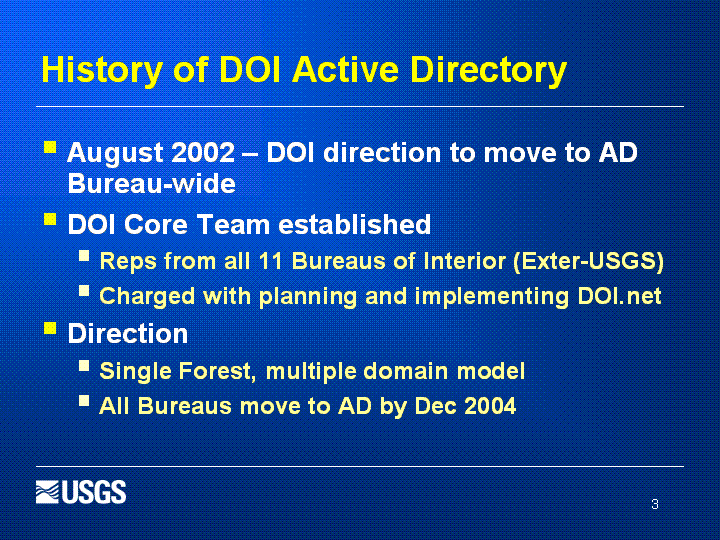
- History of DOI
Directory
- About 250 domains in USGS right now. Trying to
get to one!
- All Bureaus move to AD by Dec. 2004.
Project Phases:
- Discovery (Dec. 2003-Feb. 2004)
- Did risk assessment; completed in February 2004.
- Status-Completed: Adipt.usgs.gov
- Architecture will be documented to its fullest extent – a changing
document.
- Most documents are pretty close to complete now; three or four have
yet to
be reviewed.
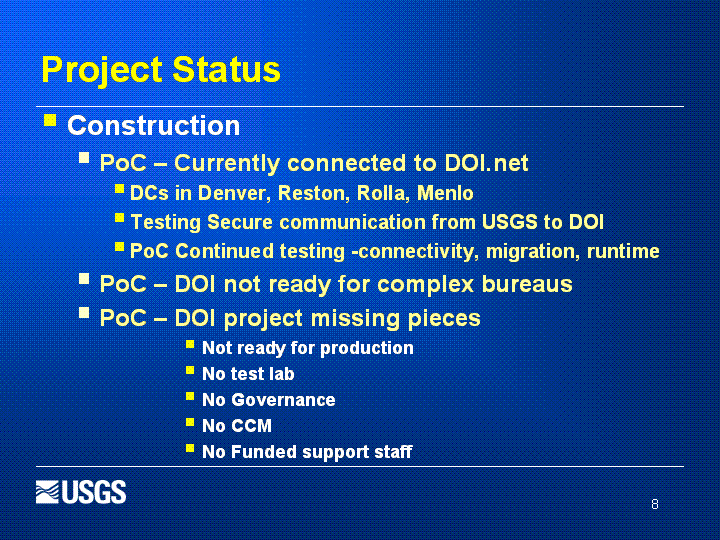
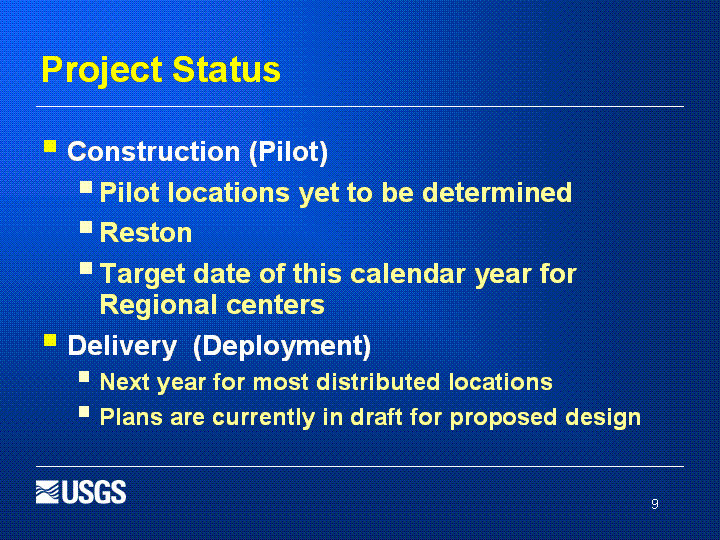
– Construction --“Proof
of concept” testing
– Pilot locations yet to be determined; first one will be Reston.
Maybe just Reston, Denver, and Menlo will be done this year;
next year for most distributed locations. Core team presented a paper to DOI.
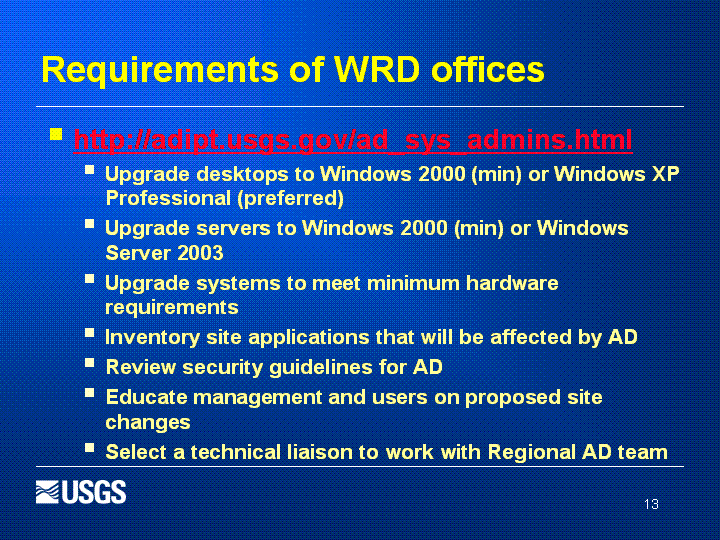
- Requirements of WRD offices
- http://adipt.usgs.gov/ad_sys_admins.html
- AD will be well into calendar year next year.
- Document to be in draft by end of July.
- Water Districts want AD, maybe not at DOI level.
- Many things will look different; no more “isolated environments.” (Forn
e-mail, we’ll just see USGS names—not DOI’s).
- Migrate locally to AD with BWTST guidance (NT 4.0 retirement); recommended
try to get everything onto one computer for each employee. Reference
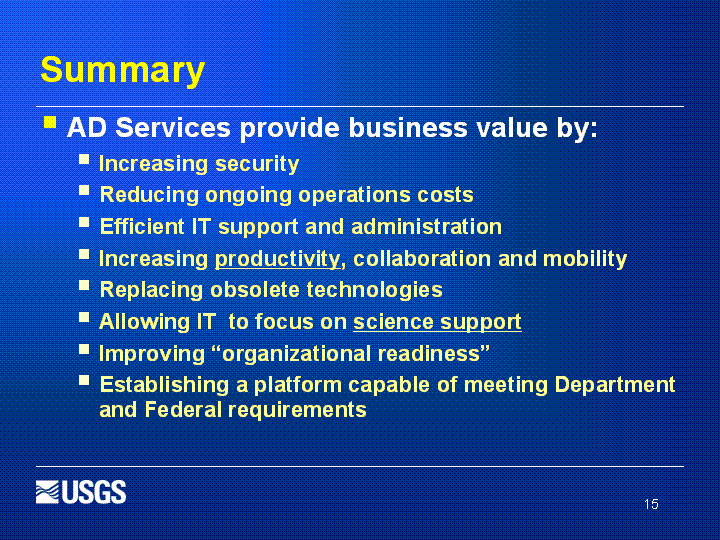
Summary slide.
- Training will be to get SAs trained…probably by latter CY 2005.
DOI may put pressure on to “rush it,” however.
- Training to be offered at ITEM 2005.
Reference USGS Architecture
Team Members email from Wendy Budd. |
| 9:45 am |
Windows 2000 and XP Mandate
Presented by: Paul Exter by telecon
Expected Outcome: What can be done to help poor districts meet
the mandate deadline?
June 2004.AK.5 -
Jim Nicholas - AD Info — Heads up to WRD
offices on needs for AD deployment via ITAC summary minutes. Reference
presentation slide 13 and slide
15.
June 2004.AK.6 -
Paul Exter — Will send XP Security Guidance to Carl Griffis
(NV) and Jim Steverson (NWQL) for formal review, then to RGIOs.
Slide #17 – For DOI policy, see Password Content
section of http://internal.usgs.gov/gio/security/doi
computer_password_policy_12-5-2003.pdf.
- It’s not consistent
now – giving password for access
(when locked out, etc.).
- Admin access is an option; requires user education & administrator
to be flexible on a case-by-case basis.
Discussion: There’s a push for people to start using XP.
There’s
an opportunity for waiver of laptops (if you need a waiver around
a science requirement). ITAC can review the policy/waiver. Individuals
can send comments to Paul. |
| 10:00 am |
BREAK |
| 10:30 |
DOI Website Moratorium Status
Presented by: Karen Klima by telecon
Expected Outcome: A moderate understanding of how to continue to meet
mission requirements while under this moratorium.
(Reference OCIO
Directive (memo draft); includes definition of "Web site.")
Memo is couple of days from being signed by Hord
Tipton
Highlights:
- More DOI control of creation of Web sites, new domains, and sub-domains.
Process will be developed to approve this. Will work with GIO and the programs.
Teleconference call in July of Web Advisory Group.
- Will be a freeze on Web-related software and hardware. One-year
limit on this freeze. Web hardware and software have not
been identified; will be by end of this fiscal year. Karen Siderelis
has ultimate responsibility
— not DOI.
Discussion:
Q: External Web sites? Is it a "new page" if it's off a District Web site?
A: A pdf off of an "old" Web site does not
count as a new page (i.e. populating a current Web site). New projects
from District
homepage? If
site is
entered through a homepage — added link — it's not "new." A
Web site has its own unique URL and number of pages attached to it. Approval
needed
of existing Web site? No, not needed. Approval needed for complete, new
beginning of URL. Changing letters before "usgs.gov"? Basically,
yes... see Karen's definition). USGS will need to have inventory of all
Web
sites. Can improve existing Web sites. (Deadline?) Approval process should
be 30 days or less; must be streamlined enough so we can continue to
do our business. Karen will need to look at this more fully. New
gage to cooperator can be "new" too. Karen would like someone
from ITAC to be on group when developing and finalizing this policy.
June2004.AK.7 — Katherine
Lins — Contact Nelson and Gerry Ryan for his nominee to
Karen Klima's Enterprise Web Team — Will sit in on
Enterprise Web group when developing and finalizing policy on waiver
of "new" Web pages (and defining
what is a extension of an already-existing Web page). Definitions of hardware
and
software that has been frozen and come up with USGS waiver approach. By early
July. Nomination for Bureau Web Advisory Group. Process for domain, etc.
H/W + SW and provide guidance for waivers. Review glossary/edit.
Discussion:
- The number of Web sites is being restricted - not necessarily the content of the Web pages.
- The Dept. has over 55,000 Web sites (some redundant and some out-of-date)
and only 70,000 employees. They wanted to push a lot of clean-up and
better monitor new Web sites.
- Will stress having all Web sites registered.
- Enterprise Web Team is given challenge to come up with a plan in next
180 days. Detailee from EPA working with them; will be working with Communications
Office and Enterprise Web group (Web Advisory Group).
- Q: How is "software" defined in this context? What does DOI mean by
software? Karen already submitted info she gathered from USGS employees
on this to DOI.
- Web group will be looking at Web page, domain, and sub-domain approval.
(They should also look at redefining terms, i.e., "Web-related" and "Web
site." DOI can interpret their directive! She'll have two subgroups.
And keep Advisory group informed. This will be communication network.
She'll send Greg copy of letter from DOI on this.
|
| 11:00 am |
Competitive Sourcing... Re-engineering
Presented by: Greg Allord
Expected Outcome: Information sharing
Competitive Sourcing update:
- Officially, the Competitive Sourcing process is continuing.
- Critical dates are that Competitive Sourcing is to be announced in
FedBizOps on August 16, 2004.
- Performance Management Team works late in CY 2004.
- Most Efficient Organization (MEO) Team works early in CY 2005.
- Decision to be made in May 2005.
- Implementation date is September 30, 2005.
- Recent evidence that we need to focus on results and not just the Competitive
Sourcing process
- Example — Forest Service given permission to get out of MEO process
- Re-engineering proposal — We made progress on the reengineering proposal.
Bob Doyle has had an initial meeting with Scott Cameron that was encouraging.
Bob Doyle has asked for a revised proposal based on his written comments
and telephone conferences. Bob Doyle will be meeting with Scott Cameron
on July 1.
- Adobe CRADA will be a future ITAC issue.
Discussion:
- Competitive Sourcing is continuing. Will be announced August 16th this
year. Performance management team will be working late this CY.
- Management's Outcome Team — Will determine what they want "publishing"
to be.
- Statement Team — Will be writing functional requirements.
- CY05 — MEO team. Will have our bid to the competitions. Official process;
decision to be made in 2005.
- Bob Doyle would make the selection and certify it. Implementation date
— 9/30/05.
(No action items.)
|
| 11:30 am |
Wireless
Waiver Process
Presented by: Tim Quinn, DOI, by telecon
Expected Outcome: An adequate understanding of the waiver process
and approval criteria
Tim Quinn is Telecommunications Manager, DOI
- 2/18/04 — He gave presentation to ITMC on strategy. Covers both telephone
and data services; covers wireless networks.
- 802.16 — Emerging wireless LAN services (more in metro or wide area)
Service delivery model — customers having to deal with multiple
devices and carriers. Needs to come into security approach.
- Wireless LANs — What architechture needed to secure environment
for traveler? You do the same things for laptop.
- CISCO architechture (probably will go with this). Any wireless LANs
have to be under the control of Chief Information Office of that Bureau
(Karen Siderelis). PCs need to be configured so they are under control
of CIO. Can't go to BestBuy and get set up with wireless card — security
breach.
- Tim's strategy: Go into detailed designs of wireless pieces, then
find a lead agency to establish a sale or service contract to buy access
points, LAN cards, software, and set up specific configurations. Once
first LAN configuration, pocket PCs will be looked into to fit into
similar arrangement.
- Can control environment of Gov't computer used at home by installing
certain encrypted package on system and building VPN network. (Tim
does not see this environment any different than airport or hotel.)
Wireless Team will be determining what that software will be to do
this.
- Non-Gov't computer for Gov't work: Negatives — Viruses; have to meet
specific minimum standards; total cost of ownership is cheaper for
Gov't to put a Gov't PC in someone's hands instead of dealing with
liabilities, etc.; still may require encryption, firewall, etc.
- Q: Can we fast track access from wireless hotels? Tim already drafted
something that uses Cisco solution. In terms of waivers, we can do
this fairly quickly. Used to communicate requirements to Info Tech
managers.
- Federal Information Processing Standards 140-2 (FIPS 140-2); need
to include which protocols you are using when requesting a waiver.
RGIOs each have standard template of this waiver, which uses FIPS 140-2.
everyone will have to use same form.
- Next step to take draft strategy document he put together and put
into hands of the team; see if they can rapidly agree. Could be within
a couple of months.)
Discussion: Using a desktop PC is an "outdated concept." A laptop with
a docking station is more the thing now. Web-browser interface is used to
get mail. Desktop won't be eliminated, but "managed." |
| 12:00 pm |
LUNCH |
| 12:30 pm | Futures of Temporary DMZs
Presented by: Kevin Gallagher; ITSOT (IT Security Operations Team):
Tim Brown - Regional GIO Security Officer and Lester North -(works for Kevin
in
Reston);
Melna Jones,
WR IT Security Operations Officer, Dave Greenlee, EROS
Basically, DMZs are servers put outside the firewall for public
file transfers where the activity is more heavily monitored. A lot in the
job of the
ITSOT
falls
out of perimeter
standards document. The more we proliferate DMZs, the more the potential
for risk. Ideal would be only four DMZs for USGS. This is still the goal,
using tools like reverse proxy.
Lester North: DOI would like all publicly accessible servers to
be under DMZs. DMZs will exist in separate IT area. Temporary DMZs were
just to
get things started; need to be relocated.
- He recommends a content solution or proxy solution. In the past, a
proxy server was a general purpose computer. Now, they've made special
purpose equipment for this task. It's an operating system
that is not generic; memory spaces are physically separated; very robust
as a security device; and increases throughout.
- Not much more to evaluate. Will have by July. Able to restrict access
into the server. This is a huge issue for NatContinuum. Scalability function
is there.
- Timeline for getting rid of Temporary DMZs? Team is just getting positioned.
Need to develop timelines yet and get guidance out, so that everyone
understands the alternatives.
- All this (hopefully) will come together before the end of this calendar
year. (From DOI's perspective, we should have done this already.)
- Local DMZs — The reverse proxy will provide more than Web content and
FTP services. No more anonymous FTP services. All FTP servers mus reserve
in DMZs. Will use NetContinuum reverse proxy capabilities.
Discussion: Tim clarified publicly accessible and info given to cooperators.
Need to transfer data that is encrypted. A server can reside in a network
segment that is not necessarily a publicly accessible DMZ.
- Goal of team: Not to limit what you can do; just change way you are doing
it so that it is in a secure way. VPN tunnel solution, another one. Cooperators
getting to our info is not prohibitive; just has to be done securely.
- Q: If a cost center has a temporary DMZ, what should ITAC members advise?
Something will be put out later by the Dept. about this. Will be like
Windows Support Team, where they can help and design solutions. Real-time
delivery issues need to be kept in mind.
- Temporary DMZs are needed and they will stay until there is an alternative
solution in place.
- Monthly scans have been going on since May; only a small portion of
the network is being scanned.
- OASAG is coming together — results of scans (?). Documents to be written
by 7/1/04. It's moving ahead as scheduled.
|
| 1:15 pm |
GIS and benefits of cross-discipline database sharing
Presented by: Dave Greenlee (EROS), Al Rea (ID), and Jacque Coles
(ID)
Expected Outcome: Identify areas where disciplines can work together.
It was suggested to set up quarterly cyber seminar to share latest activities
in datasets available. WRD, BRD & GD also has data. Perhaps each Discipline
would want to take a quarter to share their data as
well.
Reference email thread of 6/18/2004 - TNM streamgages
- C&A exercises — National Mapping made up of blanket
coverage. Not all customers rely on the Internet; National Map has
to work within different environments.
- Greenlee suggests everyone use Oracle, using
same architecture, for their C&A,
to back up their entire database. Cron job update with NWIS is done
every day. Most databases don’t
get updated very often.
- We need a coordinator (EGIS function). Greg Allord recommended Craig
Skalet to be asked about this and engage him. Dave Greenlee will contact him about this.
- Al Rea: There's
a major program to get all 25,000 gages and make sure they are all
properly located on the NHD (mostly 1:100,000 scale),
and generating an event table, linking gages to NHD. They’re hoping NWIS
will embrace this. Susan Trapanese says it’ll have be worked through the
user group; they’re working on it. Chair of GW user group is Ron Seanor
(Ruston, Louisiana).
- Q: NWIS site file — functionality in future?
SDE (Special Database Engine) can help. Database stores data-quality
measurements. Not difficult
to scope a system that can “make this happen.” A Web service and
a feature service. Distributed Director is what they are using (same
as NatWeb). Dave Greenlee will
recruit Craig Skalet to coordinate these cyber seminars. Ideas for
cyber seminars - NWIS and National Maps; ArcView implementations.
Discussion (on NWIS and specific site data, building tables, developing
links, etc.):
- Dave wants to get together a group that can proactively develop
these
links.
- Outside NWIS, Ken Lanfear is assembling a team to work on requirements
for developing a map interface to the NWIS data. We need to work in the
same direction and not duplicate our work.
- Bandwidth
issue, which can slow down use, will indicate things have to be
done differently with GIS.
Information Integration/Exchange Action Items:
June 2004.AK.8a -
Dave Greenlee (EDC) — Will recruit Craig Skalet to coordinate
quarterly cyber seminars to USGS internal customers to inform of data holdings
and feature services.
June 2004.AK.8b -
Sandy Williamson — Will assemble an ad hoc interdisciplinary
GIS/Web collaboration team and coordinate cyber seminars.
Craig Skalet
Dave Greenlee
Dave Briar
Al Rea |
Curtis Price
Ken Lanfear
Jeff Simley
|
Reference Jeff Simley email of 6/18/2004.
|
| |
NEXT MEETING DISCUSSED:
- Will be in Central Region. Suggested - Denver, Colorado; Denver
proposed, to save money and better access.
- Other proposed meeting
sites:
- Helena, MT – Dave Briar
- Bismarck, ND – NWISWeb
- Lincoln, NE – Moved/EROS; has
had series of District Chiefs; a bit unstable now.
- Iowa City, IA – Sun_TAC
- Baton Rouge, LA – BRD
- Decided on Little Rock, AR – Scientific Visualization – needs
resurgence; this office uses it a lot and they also have good SW/GW modelers;
water use.
- Will try for dates of 11/16-18/04.
|
| 3:00 pm |
Invited District Presentations
Presented by: Alaska Science Center Staff
Use
of PDA for Bear Research -- Greg Putnam
Greg spoke in lieu of Tony Fischbach, Wildlife Biologist, Walrus Research
Program, ASC.
- Greg works with Brown Bears on Kodiak Island, and with Polar Bear
project; Monitors behavior patterns of bears and tries to identify
the actual bears themselves.
- He uses Microsoft Access and Otter box.
- Can synchronize the PDA with
a field laptop.
- Pendragon software used
- Info came off of a GPS attached to a helicopter. (PALMs not
used with polar bear application.
- Pendragon just used on a PALM – not
a pocket PC.
- Can write to more than one table; had multiple backups.
Safety Environmental Specialist -- Jim Coleman
(Safety Officer)
- Works for all four disciplines. Gets good responses from Water.
- Ergonomics
with computers; not an issue in the field, but in the office, a little
bit.
- Tom Parker set up great system where user can search and
update own safety training files. It’s a UNIX database, and very
convenient.
Alaska Science Center
- Overview -- Cindy Gilder(AO for ASC)
Resources & Organization
It appears that Water programs send costs to the Cost Center level which
other Disciplines pick up at the HQ level and don't pass down.
Issue: Discrepancy between what amount to pay for Misc. expenses
(incidentals); amounts not the same across disciplines.
Handouts were distributed; includes ASC organization chart and FTE statistics.
- AK is good “beta test site” now (i.e. IDEES, purchase
order submission system)
Moving to FBMS.
Alaska Volcano Observatory (AVO) --
Chris Waythomas, USGS-Alaska Science Center (USGS Research Scientist)
- Chris
was “pinch
hitting” for Tom Murray.
- AVO is located at University of Fairbanks. (APU does not have a graduate
program.)
- Main issue for AVO to deal with is volcanic
ash affecting aircraft— especially air cargo. Alaska is one of largest
cargo holds in world.
- AVO has big budget. It costs about $2,500/day to
use helicopters for fieldwork.
- Everything is done by telemetry; no onsite
readings.
- Things would be better if they were all co-located, but that’s
not an option.
- 43 active volcanoes to keep track of (overwhelming).
Discussion:
ITAC Discussion with Steven Frenzel: Heavy
duty hard-core streamgaging, wherever they go; rivers are
deep (and usually very dynamic).
- Impossible to put boats in rivers and there are no bridges to do this.
- As
of 2 years ago, 65-70% of telemetry had DCPs.
- Because of common business practices, no funding at all or Water-discipline
specialists. No specialist time is taken out of overhead. No support
in water quality.
|
| 4:30 pm |
BREAK |
| 4:45 pm |
Impact of FISMA Action Items
Presented by: Kevin Gallagher
Expected Outcome: A moderate understanding of forthcoming requirements
and impacts of districts.
(Reference
Presentation)
- Score Card displayed (IT Security Program)
- 31-Action Plan (got it in
December 2003)
- Kay Cooke has taken responsibility for Annual Performance Plans.
- Sensitivity-level assignments (about 200 positions are “sensitive” – will
require background investigations; some IT Specialists and system owners
included and District Chiefs)
- No funding came with this; just a mandate.
- FISMA corrective action team
is trying to figure out how to address the funding for these investigations.
- Can’t
do all this by 7/31/04 – Okay if we at least have a
process in place.
- Will compare list to National Security Check list
(where some have already passed this.)
Discussion:
Looking at
C&A column on chart, between now and 7/31,
there is nothing else required in this area. But 7/31/04-7/31/05, other
things required. Kevin
can design a team to minimize impact on the field.
- Critical Infrastructure Protection (CIP)
- Systems inventory management – not
much impact.
- Procurement vehicles updated – APS (Carol Aten)– Contracting
IT people; they will need background checks (contractor responsible
for this) – existing
and future, which involve services.
- Background checks (and other functions) will probably still be going
on beyond 7/31/04.
- Kevin explained scorecard. All bureaus have to be
at “83” as
a score by July, according to DOI.
- Lowest common denominator is the score; we have an 88.5 as a score.
It’s
always higher than Department score. They’re trying to figure out which
bureau is “dragging them down.” We’re not the lowest bureau,
but we’re down there (bottom three or four). Large distributed bureaus
with large infrastructures are hard to get a good score. Scores are based on
self-assessments (until 7/31/04). Then IG will come in and “check” and
their score will go to Congress. We could end up with a “C.” (Not
too bad from an “F”!)
June 2004.AK.9
- Kevin Gallagher — Will include wireless waiver
information in next GIO notes. |
| 5:30 pm |
Adjourn for the day |
| Thursday, June 24, 2004
|
| Time |
Agenda Item,
Presenter(s), & Expected Outcome |
| 7:15 am |
Wrap-Up
All ITAC members give ownership to
constituents in identifying
issues to put into agendas.
We'll try to keep agenda a little "thinner."
Topics for next meeting’s agenda:
- Get Paul Exter on telecon and
get update on AD and C&A:
- Impacts on field
- Critical information infrastructure
- Update from ITSOT (telecon
with Lester North)
- Wireless status (Skip Dutrow)
- Enterprise Services Network (ESN)
- Publishing technology plan for competitive sourcing
and re-engineering (Greg
Allord)
- Update/follow-up on CHIDER Conference (Burl Goree)
- IDEAS & FBMS
updates (Donna Hector-Sabin)
- MY SAP (Kevin Gallagher) - ?
- ADCP and handheld demonstrations
June2004.AK.10– Jeff
Stoner — Will follow through on setting up agenda
for next meeting in November in Little Rock, Arkansas.
- Days for teleconferences – Keep 3rd Friday in the month?
Yes. Noon, Eastern time. We’ll hold them the month after meeting
and month before only (every other month), Next teleconference calls
8/20/04 and 10/20/04.
- Ground rules for conference calls: Purpose is
to track action items.
- 7/1/04 - Members to have updated minutes to me by then (those
distributed 6/22/04). Final Review: Each member that attended will
take a half day to edit, on top of individuals editing their individual
topics.
- All need to participate on committee. Minutes need to be timely.
Sandy will take lead on this. Katherine will help out.
- Kevin — Follow-up
on FISMA impact items. Kip McCarty & Lester
North replied on some questions from yesterday. Overall security training – there
is a module and all employees will receive that. CSIRT (Computer Security Incident
Response Team) roles & responsibilities document (IT events and incidents).
Tim McElhone would receive this document. Plus, at ITEM Conf. next year, there
will be DOI training on incidents & response (no date).
- Q: Who determines
the membership on CSIRT? – Consists of “incident
handlers” – a core member of C-CIRT team who will handle incident
as it occurs. They will be permanent members of the team. They work with the
points of contact…
Reference Lester
North e-mail of 6/24/2004.
- Rotation of Positions: Brian, Sonya, and Joel will
be rotating out (Data Section Chief, Studies Section Chief & Database
Chief positions will be needed). Nominations? We can nominate individuals
at next teleconference call.
- Jeff Stoner will rotate into Chair; Sonya will be rotating
out. Who will be Vice Chair?
- Katherine will ask Regional Hydrologist
to name nominees and report these at next teleconference call.
Jeff thanked Steve Frenzel, District Chief, for his hospitality. |
| 8:00 am |
E-Web
C&A Status
Presented by: Garry Neverdon, Judy Ferrier, and Karen Klima by telecon
Expected Outcome: RCS'ers will assist GIO in communicating requirements
and providing assistance to cost centers in a timely manner
Office Automation Specialized Mission (OAS)
C&A
Status -- Neverdon (by telecon)
Expected Outcome: Write-up for OAS C&A follow-up activities
including by
telecon due dates in HQ and cost centers
- 8 systems not certified yet; 4 certified during last year; preparing
documentation to certify 8 pending systems: OAS and OAG Web enclaves – by
July 2004.
- Judy Ferrier – Ran LTDA scans beginning of June; reviewing
results of vulnerability scans; will be contacting owners to remediate
them.
Also contacting
system owners for their contingency plans.
- Q: Contacting system owners?
A process gone through in April 2004. RGIOs helped spread the word
to identify public Web servers not in a C&A effort; determine
whether their system should be an Enterprise Web – 23 identified
in Eastern and Central Regions. WR has migrated to NatWeb or used reverse
proxy. Asset
inventory done + 23 reviews.
- Q: Do 23 have to be reviewed? No. NatWeb
is a subsystem. Some NT systems using interactive technologies that
don’t
work with NatWeb have been evaluated already. Those that have been
asked to prepare a C&A package: Middleton,
WI, data center (Harry House; Middleton, WI – Hosting USFWS too;
under same requirement. They will need something that tells them they
are certified.);
BRD Science Centers, WRD SD Web; Branch of Quality Systems (BQS), NWQL
component; MA & GA District Offices Web servers; WHSC (Woodshole);
Great Lakes Science Center; Patuxent Wildlife Center; and ANSS, Golden.
Started
with much larger group of assets. They’re pretty comfortable
that they are now “well on their way.”
- Due dates to produce
documents? Around middle of July 2004. Will work with asset owners
to complete entire process by mid-July. They will
be writing
a systems security plan and contingency plan (will include specifics
to their
system); required by mid-July (two local documents).
- Q: Is that it?
Gary – Yes. Risk assessment will be overarching one. They’ve
already evaluated their sytems (about 260 questions were answered).
Reference: Judy Ferrier email
of 6/24/2004 and List of Enterprise
Web assets
- No local documents needed for OAS and OAG.
- Want to get next steps out
to field by first week in August 2004.
- Working on creating documentation.
Will determine what else is needed from field to support that documentation.
Most likely, will still be in
same position as E-Web, needing local contingency plans. Will need a contingency
and security
plan
for
every
site; full risk assessment may be required.
- Privacy Act – Those
who mentioned privacy data will have to fill out Privacy Assessment
form (3-4 page document, asking about additional
controls in place).
|
| 8:45 am |
Jeff Stoner expressed appreciation to Kevin Gallagher for
his participation and Bureau IT and support.
Discussion: (Sandy and Kevin) regarding Raindance vs. Sametime; Discussion
to be taken offline.
June2004.AK.11– Scott
McEwen — Will
invite Cheryl Morris, CRGIO, to next ITAC meeting in Little Rock, AR,
November 2004. |
| 8:55 am |
Adjourned |
 Agenda and Meeting Minutes