USGS Groundwater Information
Groundwater Resources Program
 Home
Regional GW Studies
GW & Environment
Methods & Modeling
Publications
Data & Information
[an error occurred while processing this directive]
Intranet
Home
Regional GW Studies
GW & Environment
Methods & Modeling
Publications
Data & Information
[an error occurred while processing this directive]
Intranet
![[Photo: Ground water flowing out of well.]](http://water.usgs.gov/ogw/gwrp/images/flowingwell-vsm.jpg)
New & Noteworthy
USGS Groundwater WatchUSGS maintains a network of active wells to provide basic statistics about groundwater levels. ![[Image: USGS active water level wells location map.]](http://groundwaterwatch.usgs.gov/sm_ogw.png "USGS Groundwater Watch")
Other Water TopicsUSGS in Your StateUSGS Water Science Centers are located in each state. ![[Map: There is a USGS Water Science Center office in each State.]](/ogw/images/usmapsmall.gif)
|
Contents | Introduction | Importance of Ground Water to the Nation | Evolving Ground-Water Issues and USGS Programs | Relationship of GWRP to Other USGS Programs | Current Activities of the GWRP | Future Priorities for the GWRP | Concluding Remarks | STRATEGIC DIRECTIONS FOR THE U.S. GEOLOGICAL SURVEY GROUND-WATER RESOURCES PROGRAMA Report to CongressNovember 30, 1998CURRENT ACTIVITIES OF THE GROUND-WATER RESOURCES PROGRAMCurrently (1998), the Ground-Water Resources Program consists of five primary activities, briefly described below:
The Ground-Water Resources Program thus addresses a variety of information needs. As the program transitions from its exclusive focus on the 25RASA aquifer systems to broader issues, the above activities serve as prototypes for the possible future activities described below.
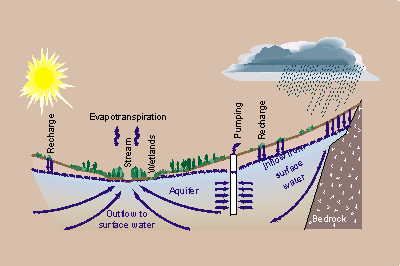
Figure 5. Availability of an adequate supply of freshwater is a significant issue affecting continued economic growth of cities and towns in the Southwest, which also contains of the most productive agricultural lands in the United States. Environmental considerations create increasing constraints on water development. For example, perennial streams, springs, and wetlands depend on ground-water discharge for their existence. In addition, the effect of climatic variability on water resources, particularly on ground-water recharge are not well understood and are a major deficiency in current models used in water management. |

 U.S. Department of the Interior |
U.S. Geological Survey
U.S. Department of the Interior |
U.S. Geological Survey
URL: http://water.usgs.gov/ogw/gwrp/stratdir/activities.html
Page Contact Information: Contact the Groundwater Resources Program
Page Last Modified: Tuesday, 03-Jan-2017 20:47:21 EST

 Press Release: