The links here are to distribution software that should be available on all the Water Resources servers. Includes info on programs, utilities, man page links and more!
Changes, where possible, full URL's to relative URL's.
Updated: 31 Oct 2003
Changes all relative URL's to full URL's.
Updated: [an error occurred while processing this directive]
A 10 step process for using Unix Netscape and Acrobat Distiller (part of FrameMaker 5.x) to produce a Postscript or PDF file containing one or more web pages
A method for generating a PostScript version of a set of Web pages
Show how often links on a web pages are used, by creating a copy of an html document where each local link is labeled with the number of times that link has been used (an example). For a list of options type the command name with no options.
Perl code temporarily unavailable (contact David Boldt for Info).
This is the program that provides the statistics seen from <http://water.usgs.gov/server_stats/>;. The analysis is designed to determine who is using your server and what pages they are looking at.
Current Version is 6.0 02Dec1999. This version is faster and
uses improved time computations.
Updated: 09 Jul 2001
This program extracts a month's data from one or more
log files. It is useful for managing your logs, and
can be combined with log_profile.pl.
Updated: 09 Jul 2001
h2o.cgi, which is running on the h2o server allows you to, among other things:
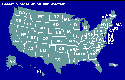 This is the imagemap or the U.S. seen on many of the WRD pages. It comes as
a compressed tar file containing the image as a .gif file and the .imf
imagemap file. The .imf file can be modified with a text editor to fit a
particular application. A README file is included with complete
instructions.
This is the imagemap or the U.S. seen on many of the WRD pages. It comes as
a compressed tar file containing the image as a .gif file and the .imf
imagemap file. The .imf file can be modified with a text editor to fit a
particular application. A README file is included with complete
instructions.
Below is a sample use of wasnew
<!--#exec cmd="/home/www/ssi/wasnew June 17,
	1998"-->
The program rotates through three icons of decreasing vividness after 1 week, 2 weeks, and 4 weeks respectively. After 4 weeks no image is displayed. The icons and times are configurable in the perl program. See the included README file for details. This program has also been written in to the h2o.cgi family of tools
The classgrep program can be used as a server-side include to pull bits of html from other documents on your site. The bit of html that you wish to extract must be tagged with an html 4.0 class. A DIV tag, with an associated class, can be used to surround the text that you wish to be able to extract. This program has also been written in to the h2o.cgi family of tools, which also documents classgrep.
If the action for a form is set to
<form
method="post"
action="mailto:email_id@usgs.gov">,
the
contents of the filled out form will be sent to the given email
address. The email message will contain a specially
encoded format of the form information, which can be decoded
using the decode.pl program.
Req is a free email request tracking system which had a perl based web interface designed for it. Read the article "A Free Problem-Tracking Program Gets a New Look" in the April 98 issue of the magazine WebTechniques to find the code and background.
On Web server water.usgs.gov a tool for automatically processing forms in a generic way has been installed. This Perl script can send a result of any form in e-mail, and/or save it to file. For instructions, go to: http://water.usgs.gov/cgi-bin/process_form. The help is a bit short and cryptic; You need to post the form to the URL given above, and you can set hidden variables to control how the form is processed and what to do with the results.
perl code for CGI and associated library