|
|
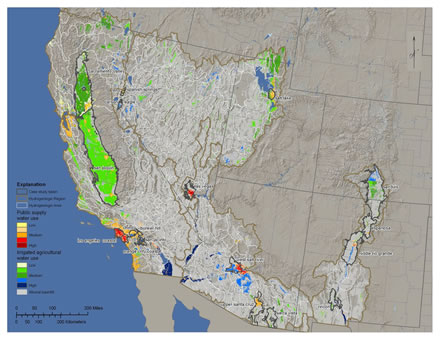
The Southwest Principal Aquifers study area is based on major surface-water drainages and the border between the United States and Mexico. Principal aquifers included in the regional analysis are the Basin and Range basin-fill aquifers in Nevada (NVBR study unit), Utah (GRSL study unit), and Arizona (CAZB study unit); the Rio Grande aquifer system in New Mexico and Colorado (RIOG study unit); and the Coastal Basin (SOCA study unit) and Central Valley (SACR and SANJ study units) aquifer systems in California. These principal aquifers consist primarily of unconsolidated to semi-consolidated basin-fill deposits, have similar land-use and water-use practices, and face many of the same water-quality issues.
Fresh ground-water withdrawals for irrigation, public-supply, and self-supplied industrial water uses in the year 2000 from 66 principal aquifers in the United States were estimated at 76,500 million gallons per day ( Maupin and Barber, 2005). The 4 principal aquifers included in the Southwest Principal Aquifers Group accounted for 26 percent of this total. Stresses such as withdrawals from wells and artificial recharge imposed on a ground-water system can result in water-quality changes.
|