
National Water-Quality Assessment (NAWQA) (public)
National Analysis of Trace Elements (public)
Trace Elements National Synthesis internal homepage - Archive of 'TE News'
To:  nawqa 91pc,nawqa 94pc,nawqa 97pc,GS-W NAWQA 01 PC,wqspecs
Cc:  nawqa nst, ahwelch, pcvanmet, rdeweese, dpkrabbe, sjryker, cory,
     mkoterba, nawqa nlt, pahamilt, egraffy, akwill, crawford
From: Dennis R Helsel/WRD/USGS/DOI
Date: 04/27/2001 12:33:38 PM
Subject:  Comparison to Canadian guidelines for sediments
The Trace Element Synthesis Team has often been asked this question:
What is the correct way to compare NAWQA trace element data in stream
sediments with the sediment quality guidelines (SQGs) published by the
Canadian Council of Ministers of the Environment?
We recommend the following:
See additional details below. For any questions, contact Pete VanMetre.
The question arises because the NAWQA bed sediment sampling protocol requires a wet sieving in the field with a 63um sieve prior to analysis, whereas the Canadian Sediment Quality Guidelines (SQGs) are developed using bulk sediment concentrations. Because trace elements in aquatic sediments are primarily associated with the finer-grained particles, the NAWQA concentrations are assumed to be higher than bulk-sediment concentrations at a site and, therefore, overestimate sediment toxicity relative to the SQGs.
Two approaches for comparing NAWQA bed-sediment data to SQGs have appeared in recent USGS/NAWQA reports: (1) estimate the bulk sediment concentration using the sieved concentrations and grain-size data prior to comparisons and (2) use the sieved data and qualify the comparison as a worst case. For example:
We obtained a data set from Art Horowitz containing trace element concentrations in both bulk aquatic sediment and in the fine fraction (<0.063 um; same sieve size as used by NAWQA) and made a limited evaluation of the two approaches described above. The data set contained 8 samples ranging in percent fines from 1 to 95 percent. Using these data we calculated "estimated bulk concentrations" by multiplying the percentage of the sample that was less than 63um by the detected trace-element concentration (same as WRIR 99-4197). Results of these calculations for 4 trace elements are shown in figure 1.
In figure 1 we see that predicted bulk concentrations based on the fine concentrations are fairly similar when percent fines in the sample is greater than about 60 percent, but when percent fines is less than 60 percent, predicted concentrations significantly under-predict measured bulk concentrations (ratios greater than 1). The smaller the percentage of the sample that is made up of fines, the worse the prediction. This is because the prediction assumes, incorrectly, that all of the trace element occurs in the fine fraction. The effect of using this approach is to underestimate the potential toxicity or concern for aquatic life of sediments (based on SQGs), with potential gross underestimation when the percent fines is less than about 60 percent.
In figure 2 we plotted the ratio of measured fine-fraction concentrations to measured bulk concentrations versus percent fines in the sample. Here we see that the measured fine-fraction concentration is a reasonable predictor of (measured) bulk concentration only when percent fines is greater than about 70 percent. For samples where it is less than about 70 percent, fine-fraction concentrations overestimate or grossly overestimate bulk concentrations. The effect of using this approach is, therefore, to overestimate sediment toxicity or concern for contamination (based on SQGs), with potential gross overestimation when the percent fines is less than about 70 percent.
Thus, both approaches work reasonably well with sediments that are dominantly fine grained (greater than 60-70 percent fines), and both work very poorly with sediments that are dominantly coarse. Below 60-70 percent fines in a sample, the errors introduced by the two approaches are opposite. Estimated bulk concentrations grossly underestimate the potential concern whereas unadjusted fine concentrations grossly overestimate the potential concern.
Therefore, we recommend the following:
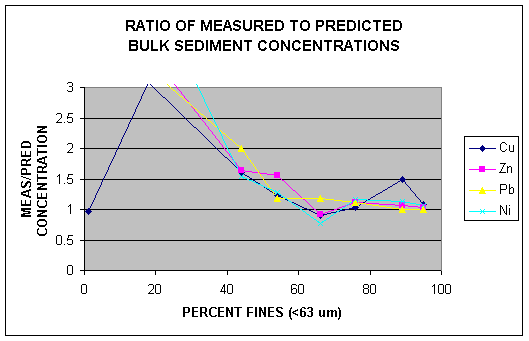
Figure 1. The reliability of predicted bulk sediment concentrations as indicated by the ratio of measured to predicted concentrations as a function of percent fines in the sample.
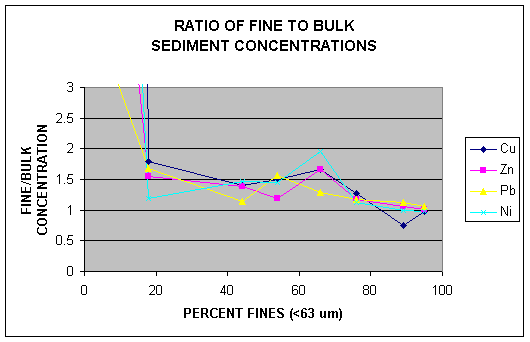
Figure 2. The relation between measured fine and bulk sediment concentrations as a function of percent fines in the sample.
Visit the TE external page at: http://water.usgs.gov/nawqa/trace/ for up to date info on regulations, publications, etc.
The TE synthesis internal page has much info for study units:
http://water.usgs.gov/nawqa-only/trace/
including all the TE News. The previous four were:
v.14  Changes in radchem data reporting          9/29/00
v.15  New arsenic MCL at 10 ug/L                 1/19/01
v.16  New methylmercury criteria                 2/05/01
v.17  TE sampling in the 01 Study Units          4/02/01
Trace Element National Synthesis internal homepage - Archive of 'TE News'
National Analysis of Trace Elements (public)
National Water-Quality Assessment (NAWQA) (public)
This page is http://water.usgs.gov/nawqa-only/trace/tenews/v18.html
Email comments/questions to traceweb@usgs.gov
Last modified: 30Apr2001