National Water-Quality Assessment (NAWQA) (public)
National Analysis of Trace Elements (public)
Trace Element National Synthesis internal homepage
Dennis A. Wentz -- October 5, 1999
On May 8th, TE Synthesis released a new webpage,
WRIR, and fact sheet on arsenic in ground water of the U.S.
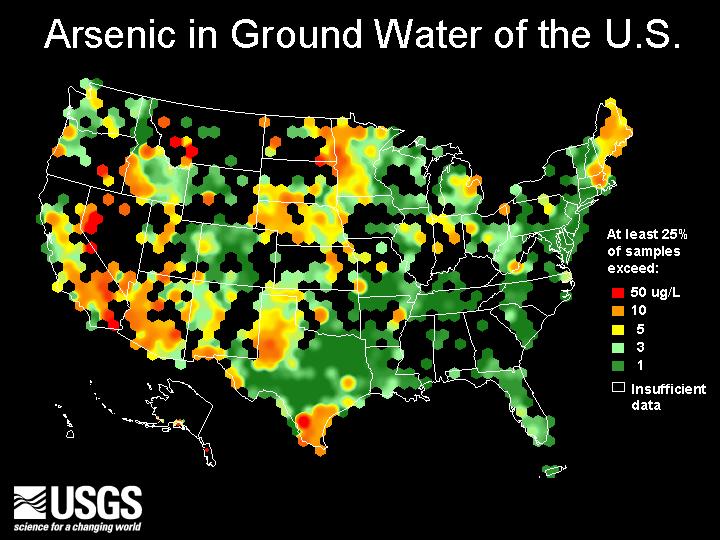
TE Synthesis is currently updating the national arsenic maps in these pubs by adding data from state agencies. Here's the current draft map of arsenic in ground water (79 Kb, JPEG) -- note the new data for Texas, Minnesota, and New England.
Major findings from 1991 NAWQA Study Unit reports and several national publications include:
Common geologic sources of arsenic include sorbed or coprecipitated arsenic in iron oxide coatings on mineral grains and impurities in pyrite and other metal sulfides (Welch, Westjohn et al., in press). Geothermal springs are important sources in the West, as are lakes and shallow ground water in hydrologically closed basins, where evaporative concentration rates are high.
Anthropogenic uses of arsenic include wood preservation (greater than 90% of current total U.S. use), agrichemicals (mostly for cotton), glass production, feed additives for poultry and swine, semiconductor manufacturing, and petroleum refining (U.S. Environmental Protection Agency, rev. July 28, 1999; Welch, Westjohn et al., in press). Agricultural application (primarily of lead arsenate on fruit orchards) was the dominant use of inorganic arsenic prior to being banned in the 1980s and 1990s. Available data are insufficient to show strong correlations between arsenic concentrations in ground water and application of arsenical compounds to agricultural land (Welch, Westjohn et al., in press); however, contaminated soils in such areas could be a source of arsenic to ground water.
Arsenic causes skin, lung, bladder, liver, and kidney cancer in humans (National Research Council, 1999; U.S. Environmental Protection Agency, rev. July 28, 1999) . It also has been reported to adversely affect development; hearing; the vascular, gastrointestinal, and nervous systems; and to be associated with diabetes.
The present arsenic drinking water Maximum Contaminant Level (MCL) of 50 µg/L applies to the sum of all arsenic forms in finished drinking water. The MCL was established by the Safe Drinking Water Act Amendments of 1986 (U.S. Environmental Protection Agency, rev. July 28, 1999). A current Health Advisory (HA) of 2 µg/L, based on a lifetime cancer risk of 1:10,000, also is in effect (U.S. Environmental Protection Agency, 1996). The Safe Drinking Water Act Amendments of 1996 require the USEPA to review the current MCL and propose an arsenic rule by January 1, 2000. A final rule is due by January 1, 2001. The effective date for a revised MCL will be 3-5 years after the final rule is issued, thus, the USEPA plans to issue a revised HA for arsenic in early 2000. Because it seems likely that the USEPA review will result in a lowering of the arsenic MCL, Study Units should consider comparing arsenic concentrations to the current MCL of 50 µg/L and to lower values. The current HA of 2 µg/L and the World Health Organization (WHO) (1996) provisional guideline of 10 µg/L are logical choices.
National recommended aquatic life criteria for arsenic (U.S. Environmental Protection Agency, 1999) were derived from data for trivalent arsenic but are applied to the sum of all measured arsenic species, expressed as dissolved (filtered) concentrations.
| Criterion | Arsenic Concentration (µg/L) |
|---|---|
| Freshwater (maximum concentration) | 340 |
| Freshwater (continuous concentration) | 150 |
| Saltwater (maximum concentration) | 69 |
| Saltwater (continuous concentration) | 36 |
More than 17,000 USGS analyses of arsenic in potable ground water from 595 U.S. counties were compared to data from the National Arsenic Occurrence Survey (Frey and Edwards, 1997). Results indicate that the USGS data are broadly representative of source (untreated) ground water commonly used by public supply systems (Focazio et al., 1999; Welch, Helsel, et al., 1999; Welch, Watkins, et al., 2000). Evaluation of the USGS data suggests that decreasing the MCL to 20 µg/L would increase the frequency of MCL exceedence in source ground water over that for the current MCL, but that less than 5% of public supply systems would be affected at either level. Decreasing the MCL below 10 µg/L likely would result in increased MCL exceedences for public water supplies, particularly those that are untreated. For example, at an MCL of 2 µg/L, about 20% exceedences would be expected. The USGS data also were evaluated to estimate the risk of withdrawing ground water with arsenic concentrations greater than certain levels, and the results have been displayed, by county, on a map of the United States (Welch, Watkins, et al., 2000; fig. 3). A tabular summary of the results (below) indicates that the percentage of counties with a 10% chance of exceeding the arsenic MCL increases rapidly as the proposed MCL decreases.
| Arsenic Concentration (µg/L) |
Percentage of U.S. Counties with at least a 10% Chance of Exceeding the Indicated Arsenic Concentration |
|---|---|
| 2 (HA) | 67 |
| 5 | 48 |
| 10 (WHO guideline) | 30 |
| 20 | 14 |
| 50 (MCL) | 4 |
In general, arsenic concentrations greater than 10 µg/L in ground water from the USGS data set occurred more frequently in the western United States than in the East. Studies in New England, the Upper Midwest, and Oklahoma during the past decade, however, indicate that values greater than 10 µg/L are more common than previously thought.
Several 1991 Study Units and one pilot Study Unit discussed arsenic concentrations in water.
An evaluation of more than 20,000 USGS and other analyses of arsenic in potable and nonpotable ground water by Welch, Westjohn et al. (in press) indicates the following:
Focazio, M.J., Welch, A.H., Watkins, S.A., Helsel, D.R., and Horn, M.A., 1999, A retrospective analysis on the occurrence of arsenic in ground-water resources of the United States and limitations in drinking-water supply characterizations: U.S. Geological Survey Water-Resources Investigations Report 99-4279, 21 p.
Frey, M.M., and Edwards, M.A., 1997, Surveying arsenic occurrence: Journal of the American Water Works Association,
v. 89, p. 105-117.
Fujii, Roger, and Swain, W.C., 1995, Areal distribution of selected trace elements, salinity, and major ions in shallow ground water, Tulare Basin, southern San Joaquin Valley, California: U.S. Geological Survey, Water-Resources Investigations Report 95-4048, 67 p., 1 plate.
Hinkle, S.R., and Polette, D.J., 1999, Arsenic in ground water of the Willamette Basin, Oregon: U.S. Geological Survey, Water-Resources Investigations Report 98-4205, 28 p., 1 plate.
Abstract PDF (1,200Kb)
Morace, J.L., Fuhrer, G.J., Rinella, J.F., McKenzie, S.W., and others, 1999, Surface-water-quality assessment of the Yakima River Basin in Washington--Overview of major findings, 1987-91: U.S. Geological Survey, Water-Resources Investigations Report 98-4113, 119 p.
Abstract PDF
National Research Council, 1999, Arsenic in drinking water: Washington, D.C., National Academy Press, 310 p.
U.S. Environmental Protection Agency, 1996, Drinking water regulations and health advisories: U.S. Environmental Protection Agency rept. EPA 822-B-96-002 [variously paged].
U.S. Environmental Protection Agency, 1999, National recommended water quality criteria--Correction: U.S. Environmental Protection Agency rept. EPA 822-Z-99-001, 25 p. (URL http://www.epa.gov/ost/standards/wqcriteria.html).
U.S. Environmental Protection Agency, rev. July 28, 1999, Drinking water priority rulemaking--Arsenic: accessed September 1, 1999, at URL http://www.epa.gov/ogwdw/ars/arsenic.html (see also related internal links from this page).
Welch, A.H., Helsel, D.R., Focazio, M.J., and Watkins, S.A., 1999, Arsenic in ground water supplies of the United States, in: Arsenic exposure and health effects, W.R. Chappell, C.O. Abernathy and R.L. Calderon, Eds., Elsevier Science, New York, pp. 9-17.
Welch, A.H., Watkins, S.A., Helsel, D.R., and Focazio, M.J., 2000, Arsenic in ground-water resources of the United States: U.S. Geological Survey Fact Sheet 063-00, 4p.
Welch, A.H., Westjohn, D.B., Helsel, D.R., and Wanty, R.B., in press, Arsenic in ground water of the United States--Occurrence and geochemistry: Ground Water v.38, no.4.
World Health Organization, 1996, Guidelines for drinking-water quality--Volume 2, Health criteria and other supporting information (2d ed.): Geneva, World Health Organization, 973 p.
Trace Element National Synthesis internal homepage
National Analysis of Trace Elements (public)
National Water-Quality Assessment (NAWQA) (public)
This page is water.usgs.gov/nawqa-only/trace/summary/arsenic_2p.html
Email comments/questions to traceweb@usgs.gov
Last modified: 27Sep1999