
U.S. Geological Survey
National Water-Quality Assessment Program
USGS Internal Access Only
Water-Quality Issues
 The natural water quality of ground water in aquifers is related to the quality of recharge water, the mineralogy of soils and aquifer sediments, the residence time in the ground-water flow system, and the presence of nearby saline water. Ground water moving through aquifers generally reaches chemical equilibrium with the aquifer sediments. Accordingly, natural ground water quality changes very little over time. Also, ground water generally contains higher concentrations of dissolved minerals than surface runoff and stream water because it remains in contact with the aquifer sediments for much longer periods. Human activity also affects ground water quality.
Aquifers composed of readily dissolved limestone and that receive recharge from overlying aquifers (rather than rainfall), such as the Upper Floridan aquifer also have higher dissolved solids concentrations. Chloride concentrations are sometimes higher in the intermediate and Upper Floridan aquifer because of longer residence times of water in the ground- water flow system and the presence of saline water in coastal areas. The spatial distribution of chloride and dissolved solids concentrations in the Upper Floridan aquifer show that most of the high concentrations are in southern
Saltwater encroachment in ground-water supplies is a concern in coastal areas of
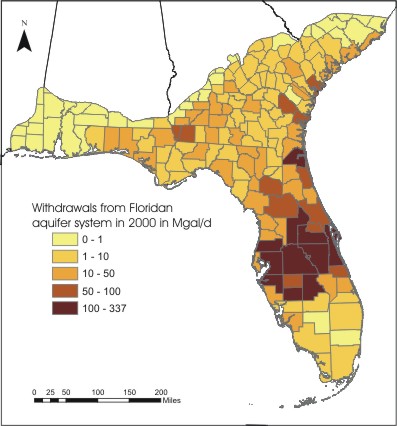
Despite concerns about ground-water quality, quantity, declining water levels in some areas, and saltwater encroachment, the Upper Floridan aquifer has large areas that contain large quantities of high quality water for public supplies. This includes areas where the aquifer is thick, transmissivities are high, recharge amounts are large, and water quality is unaffected by saltwater encroachment. Because these areas include areas where the aquifer is unconfined and karst features such as sinkholes and springs occur, ground-water flow velocities are fast, these areas are extremely vulnerable to contamination from surface sources. Potential sources of contamination include waste disposal impoundments, underground storage tanks, drainage wells, septic tanks, landfills, hazardous waste sites and agricultural chemicals.
Major water-quality issues are related to the susceptibility of the aquifer, some of which include:
- In unconfined and poorly confined areas, karst features, such as sinkholes and conduits, provide direct pathways for contamination
- Interaction with surface water and rehydration of wetlands near public supply well fields cause elevated DOC which can lead to formation of trihalomethanes during disinfection with chlorine
- Elevated nutrients and pesticides in the aquifer, in springs, and the
- Emerging contaminants detected in
- Radon has been elevated in many parts of the aquifer, especially in poorly confined (semiconfined) and confined areas because of the confining unit composition.

