
U.S. Geological Survey
National Water-Quality Assessment Program
USGS Internal Access Only
Water-Quality Issues
The main water quality issues common among the GRSL, NVBR, and CAZB study units are:
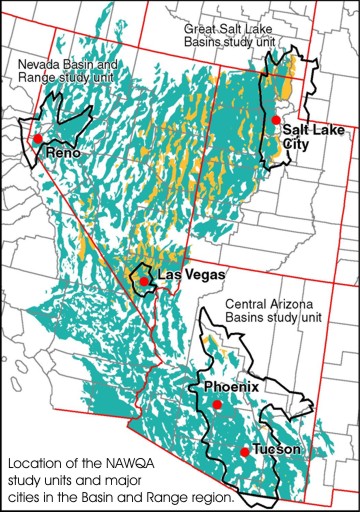
1. Increased dissolved solids concentrations in ground water used for municipal and domestic water supplies caused by the concentration of salts in irrigation water that recharges ground water, the accumulation of salts in ground water and soils where through-flowing drainage is minimal, urban runoff to ground water, transport of contaminants from naturally, salty rock formations and water-bearing units induced by pumping, and importation and recharge of surface water containing greater concentrations of dissolved solids than local ground water.
2. Effects of urbanization (the extension of urban land into rural and agricultural areas and increased density of development) on the amount and kind of water use and water quality due to land and stream-channel disturbance, chemical use, changes in the amount of water applied for irrigation and its distribution, increased traffic and impervious surfaces, and increased waste discharges to surface and ground water.
3. Adverse effects on human and aquatic-life health and water use because of infiltration of irrigation water containing pesticides applied to crops.
4. Adverse effects on human and aquatic-life health and water use from past and current mining activities.
5. Natural sources of trace elements and radionuclides at concentrations of public-health concern in ground water.
6. Adverse effects of use and recharge of imported water and water reuse on the continued suitability of ground-water supplies for beneficial uses (mainly as a result of increased concentrations of dissolved solids but also the introduction of anthropogenic chemicals to water supplies).
With the resources available, NAWQA cannot address all of these issues. The most important issues common to the GRSL, NVBR, and CAZB study units are increased dissolved-solids concentrations and urbanization. In focusing on these issues NAWQA also will be able to partially address some of the other issues such as natural sources of trace elements and radionuclides where study areas dealing with increased dissolved-solids concentrations and urbanization overlie these source areas. Also, as the population, area, and intensity of urbanization increase in these study units, the amount of imported water and water reuse and reclamation is likely to increase. Thus, studies dealing with urbanization will also encompass to some degree the effects of water importation and reuse.

