Report Proposal Status:
Original 2 pager First Update: 00/00/00 --changes marked in red print
Second Update: 00/00/00 --changes marked in green print
Principal Aquifer:
Aquifer Name(s): BARA - Basin and Range / California Aquifers; Rio Grande, Colorado River and Great Basins (MRB 6); California River Basins (MRB 8)
Lead Contact: Sue Thiros
Proposed Report Title: Status of Water Quality in the Carbonate Aquifer in the Basin and Range Province
Publication Format: The publication of these data and interpretations might best be presented as a chapter in a Hydrologic Atlas series devoted to hydrologic issues in the Great Basin (HA-694). The publication would primarily be map based with illustrations used in place of text. It would be somewhat similar to NVBR cycle 1 map reports for the Reno and Las Vegas SUS. Parties interested in the report will be asked if they would prefer a map report with plates or a WRIR type report with figures.
Scope:
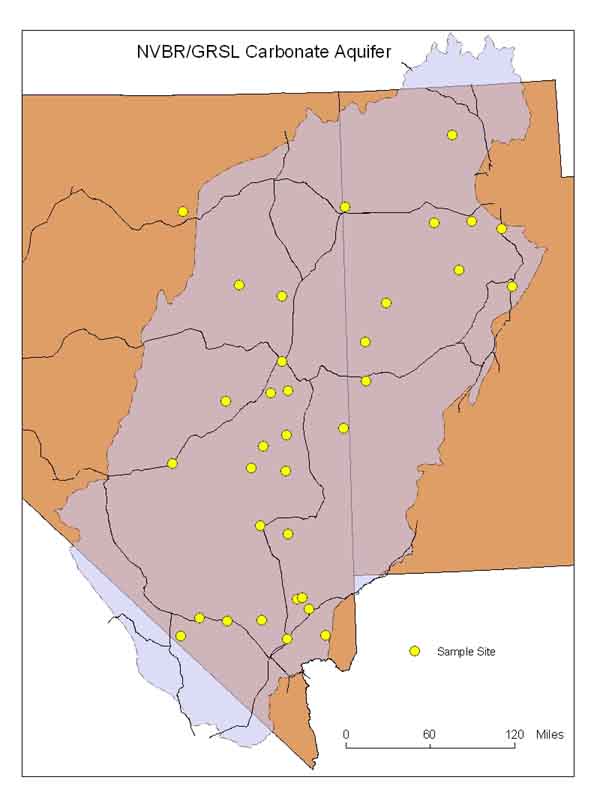
Major Aquifer Study completed in 2003 on carbonate rock aquifer of Nevada and Utah. Ground-water sites were sampled for major ions, trace elements including tungsten, nutrients, pesticides, VOCs, stable isotopes, tritium and some third party carbon-14 age dating and other isotopes.
Study Units: NVBR and GRSL
Time Period: Early 1980s to 2003; some historical data; focus on recent sampling
Land Use(s): Primarily range land
Inter-Regional Principal Aquifer Proposal? Yes/No: Explain: No
Constituents:
Expected Authors:
Lead: Schaefer
Contributing: Rosen, Thiros
Objectives:
Data Interpretation Approach and Feasibility:
Number of Sites/Components (e.g., nutrients, pesticides):
All NAWQA Major Aquifer Study sites (30) with major ions, trace elements including tungsten, nutrients, pesticides, VOCs, stable isotopes, and tritium. Several earlier studies by USGS in southern portion of province include majors, trace elements and isotopes. Studies by Desert Research Institute (DRI) in the early 1980s include several analyses throughout the province primarily major ions, but some isotope data. Recent sampling in southern Nevada by the National Park Service (NPS) will provide additional isotope and carbon-14 data.
Methods:
Standard methods such as mass balances and delineating flow systems based on stable isotope information will be used to examine the chemical quality of the various flow systems within the aquifer. Complexity within individual flow system will be examined based on available water quality information and water level data. The relationship between flow systems and water quality will be addressed by comparing existing NAWQA data (water quality and isotopes) to existing RASA data (water levels and hydrology). The project will be reviewed later in FY04 to make sure it is on schedule.
Data Availability and Processing:
Data from all USGS studies are available. Most DRI and NPS data is not in the database, but can be easily added.
Staff Availability: Yes
Complexity: Low to medium – Flow systems within the carbonate aquifer are fairly well defined by previous RASA modeling and sampling.
Risks/Contingencies: Nothing specific
Other Program Contacts: National Synthesis Teams, Death Valley Regional Flow Model Team, and other principal aquifer teams that have carbonate aquifers ( Edwards-Trinity, Floridan, Piedmont & Blue Ridge) . This analysis and report will provide information for synthesis with other major carbonate aquifers across the country as proposed by Ann Ardis, coordinator for the Edwards-Trinity Principal Aquifer.
Expected Outcome:
Ground water quality in the carbonate aquifer is, for the most part, very good. Water from wells sampled near outcrops of the carbonate aquifer likely has a much shorter residence time resulting in a potential for detection of anthropogenic compounds. Flow times within the aquifer systems, away from recharge areas, are on the order of thousands of years so any contaminants introduced to the flow systems probably have not reached the sampling points. Anthropogenic compounds detected in water sampled down gradient from recharge areas may have been introduced at the well as a result of poor well construction or completion.
Why is this topic important to report on?
The carbonate aquifer in the Basin and Range province of Nevada and Utah ( Great Basin) is one of the larger regional aquifer systems in the United States. Unlike other large regional aquifers in the country, the Great Basin system is comprised of several individual flow systems. Information on water quality within these systems fills a large gap in the areal coverage of the United States. Although population density within the province is low (1 per square mile) the potential for increased use is there with two of the fastest growing cities in the west located within the aquifer’s borders. Increased use of ground water from this regional system is expected in the next few years and may induce degradation of the current ground water quality. The Basin and Range Carbonate Aquifer MAS provides baseline water-quality information that can be used a reference as the aquifer is developed.
Why does this topic need to be addressed now?
Phenomenal growth rate of urban areas in the west have put increasing demands on traditional water sources. The cities of Las Vegas and Salt Lake are both looking at the carbonate aquifer for additional water supplies to meet the increasing need. Several recent decisions by the Nevada State Engineer will allow substantial pumping of ground water in the southern portion of the aquifer. The installation of wells should be managed carefully if water-quality data indicate the aquifer is vulnerable to contamination introduced from well-construction practices.
Why is it appropriate for this topic to be addressed by the USGS? NAWQA? This Regional Team?
The USGS through the NAWQA program and other national and district programs has the resources to address this topic, including consistent data sets and methodologies, as well as the spatial and temporal scope to provide a broad picture of the topic.
Who cares and why?
The Las Vegas Valley Water District, Southern Nevada Water Authority, Jordan Valley Water Conservancy District, Tooele County, and other water suppliers in the Great Basin could use this report. These agencies and suppliers are actively looking at the carbonate aquifer to support the increasing population in the Las Vegas and Salt Lake City metropolitan areas and interest from other expanding urban areas will grow. Las Vegas water suppliers provided additional funds to add analytes to the NAWQA suite of constituents and two USGS-local entity cooperative projects in Utah paid for age-dating/dissolved gas analysis of samples collected within their study areas. Water samples have been archived in case outside funds from interested cooperators are available for additional work related to this study.
National Park Service and U.S. Fish and Wildlife Service have vested interests in many of the springs that issue from the carbonate system and have additional data that may be shared with the analysis.
Selected References:
Budget: Budget costs are based on labor to compile and analyze data sets for the carbonate aquifer. Most analysis will be done within the Nevada District with assistance from the Utah District. Some travel is included for meetings between staff. Costs for GIS and report processing are included for Nevada staff.
Salary rates in FY05 are 1.05 the rates in FY04 to account for inflation.
FY04 FY04 FY04 FY04 FY04 FY04 FY04
Benefits +
Leave
(Net rate)
Direct
Charges
Overhead
fare, motel,
perdiem, etc)
hours
percent time
on report
for this reportDon Schaefer NVBR Michael Rosen NVBR Doug Shipley NVBR Karen Thomas NVBR Sue Thiros GRSL Reports Specialist -
ReviewerNVBR Reports Specialist -
Proof ReaderNVBR Total for FY04 FY05 FY05 FY05 FY05 FY05 FY05 FY05
Benefits +
Leave
(Net rate)
Direct
Charges
Overhead
Publication
hours
percent time
on report
for this reportSUID Don Schaefer NVBR Michael Rosen NVBR Doug Shipley NVBR Karen Thomas NVBR Sue Thiros GRSL Reports Specialist -
ReviewerNVBR Reports Specialist -
Proof ReaderNVBR Total for FY05 Total for project