4. NPS-U.S. Geological Survey Water Quality Assessment and Monitoring Partnership
Call for FY 99 Projects Proposals
: For the first time in FY 1999, water quality project funding is expected to be available from the U.S. Geological Survey’s Water Resources Division (USGS-WRD) to address the large backlog of National Park Service water quality assessment and monitoring needs identified in park resource management plans (RMPs). If Congress approves funding to implement the President’s Clean Water Action Plan, project funds totaling $2.4 million are expected to be allocated from the USGS-WRD National Water Quality Assessment (NAWQA) Program budget and the USGS-WRD Hydrologic Networks and Analysis Program budget to implement water quality projects in parks. An implementation plan for this expected Water Quality Assessment and Monitoring Partnership has been developed by NPS and USGS and is available upon request from NPS-WRD.
As described below, parks will compete for projects to be funded as part of this partnership by submitting RMP project statements, together with a statement addressing the ranking criteria. No project funds will be transferred to participating parks. Rather, parks will collaborate with USGS District Offices that will conduct the water quality assessments and monitoring studies needed to satisfy the park needs specified in the RMP project statements. Very early during the process of assembling project proposals for submission, parks must contact local USGS offices to inform them of park needs, discuss strategies, and receive assistance in revising or rewriting RMP project statements and the statement addressing the ranking criteria. Each submission should contain a separate page with the signature of the local USGS District Chief indicating that the work is feasible and the schedule and costs are appropriate. Also, USGS will indicate which USGS-WRD program is best suited to implement the project. Variable size and multi-park projects will be considered for funding through this program.
Prioritization and selection of projects will be the responsibility of a work group made up of individuals from both NPS and USGS. If selected, parks will work with appropriate USGS offices to develop project study plans or scopes of work. This stage may involve negotiation among parks and USGS on project activities and deliverables. The NPS-USGS work group will conduct final reviews of project study plans prior to approval of project funding. The NPS Water Resources Division will participate on the work group and will provide assistance to parks during all stages of the process.
In addition, separate RMP project statement submissions documenting the need for specific water quality technical assistance from USGS are invited through this program call. Up to $200,000 of the allocated program funds may be directed toward technical assistance provided by USGS to parks.
Send submissions to: Chief, Water Resources Division, 1201 Oak Ridge Drive, Suite 250, Fort Collins, Colorado, 80525.
Tentative Annual Number of Projects To Be Funded and Funding Amounts:
5-7 Intensive Studies: $100,000+/project
8-10 Synoptic Studies: $50,000/project
20-22 Fixed-Station Monitoring Studies: $50,000/project
18-20 Technical Assistance Requests: $10,000/request
Project duration: Variable, depending on the nature of the park issue and type of study. Projects should be completed in the time specified in the project study plan.
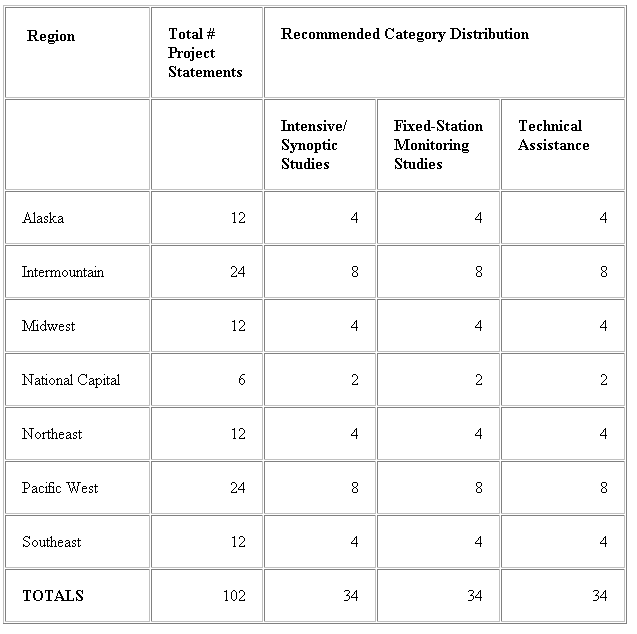
Number of projects allowed per region: See "General Instructions" for an explanation of the process used.
The limit of 102 total submissions is intended to keep the proportion of submitted proposals that receive funding at approximately 50%. Within the total allocation for a region, the number of submissions may be adjusted among categories based on priority needs.
Scope of Projects: Projects may encompass individual park needs, combined needs of several parks, combined needs of several clusters or regions, and/or Servicewide needs.
Project statements representing multi-park, multi-cluster, and Servicewide projects are appropriate; however, such projects must be related to project statements in appropriate park RMPs. Project statements are encouraged which include a data analysis and interpretation component by USGS to make the information immediately applicable by NPS resource managers and also make specific provisions for park interpreters and the USGS to present the information to the public.
Subject of Projects
Intensive Studies: Relatively large projects of long or short duration that require in-depth study of park water quality. Intensive studies will be designed to characterize the existence, severity and extent of known or suspected water quality problems. These studies also will focus on understanding the causes of water quality contamination and the implications of water quality impairment to aquatic biota. Most intensive studies will be strongly issue-driven and oriented towards the highest priority water quality management issues confronting the National Park Service.
Synoptic Studies: Short-term investigations of water quality from several sites during selected seasonal periods or hydrologic conditions. Synoptic monitoring studies will be designed to focus on park-specific issues that may or may not have broader regional implications. Synoptic studies are intended to provide a quick assessment of aquatic conditions at selected locations and to evaluate the spatial relationships or contributions to those conditions, or to provide baseline data and information where little or none exists.
Fixed-Station Monitoring: Monitoring which documents long-term trends in water quality and determines if management actions are achieving water quality objectives. Fixed-station monitoring will be designed to enable park managers to know the health of nationally significant water bodies under NPS jurisdiction, know the effects of actions taken to remediate water pollution problems in parks, and document whether activities external to parks adversely affect park water quality. Generally, fixed-station monitoring will be implemented using a "site rotation" concept (see implementation plan).
Technical Assistance: Technical assistance from USGS will consist of evaluating water quality information and issues for the NPS to assess watershed management, engineering, maintenance or regulatory actions to protect, mitigate or restore park water quality conditions.
Selection and Approval Process: An NPS-USGS work group will evaluate the submitted project statements using the evaluation criteria in this call. A list of priority projects will be developed for each funding category.
For the projects chosen for funding, detailed study plans (or scopes of work) must be developed. The study plans will be evaluated for technical adequacy by each park and participating USGS District Office, then approved by the applicable USGS Regional Office. The NPS-USGS work group will then review USGS-approved study plans, with the assistance of independent reviewers as appropriate. Study plans requiring revision will be returned to the USGS offices and/or parks. Projects will not be implemented until study plans have received final approval from the NPS-USGS work group.
Schedule: See general information.
Technical assistance and guidance are available from the NPS-WRD and the USGS-WRD in selecting RMP project statements for submission and in preparing the overall project proposal submission. To obtain such assistance and/or information (including names and telephone numbers of USGS District personnel near your park), please contact Barry Long, NPS-WRD, at (970) 225-3519 or Walton Low, USGS-WRD, at (703) 648-5707. Use the address WLOW@USGS.GOV to contact Walton by email.
For more information on this new NPS-USGS Water Quality Assessment and Monitoring Partnership, or to obtain a copy of the implementation plan for the partnership referenced earlier in the call, please contact Barry Long, NPS-WRD, at (970) 225-3519.