In Reply Refer To:
Mail
Stop 412 October
12, 2000
OFFICE OF WATER QUALITY TECHNICAL MEMORANDUM 2001.01--REVISED
Subject: National Stream Quality Accounting
Network, Fiscal Year (FY) 2001
This
memorandum contains a summary of National Stream Quality Accounting Network
(NASQAN) status and funding for FY 2001. Details of NASQAN station operation
and protocol changes are contained in the NASQAN National Operations memo,
which will be released at the National Meeting to be held October 17-19 in Jackson,
MS.
NASQAN
Stations
The
NASQAN station network (Table 1) has changed appreciably since last year,
reflecting the decision to shift resources from the Columbia and Colorado
basins to the Yukon basin for the next five years. NASQAN will suspend operations at all
stations in the Columbia and Colorado with the exception of three index
stations in these basins. In addition to the routine water-quality monitoring
in the lower Columbia River, a special study will be conducted to investigate
the use of continuous turbidity data to refine the estimates for suspended
sediment flux and delivery to the Columbia Estuary. NASQAN has also withdrawn support for three stations that were
previously operated in conjunction with the National Water Quality Assessment (NAWQA)
Program: Rio Grande at El Paso, TX; Yellowstone River near Sidney, MT; Platte
River at Louisville, NE. NAWQA will assume full responsibility for operating
these stations.
There
are a few other changes in the network configuration in the Mississippi and Rio Grande basins. In the Mississippi, the
NASQAN site in South Dakota will be moved from Pierre to Yankton, below all of
the major storage reservoirs in the Missouri. A new site will be started on the
Ohio River at Sewickley, PA, to characterize the upper Ohio basin because NAWQA
will not be operating the Allegheny-Monongahela study unit during Cycle 2. In
the Rio Grande, event samples have been eliminated. The funds saved from this
activity will be used for measurement of continuous conductivity at three sites
within the basin and for surveys of the two major reservoirs. In addition,
discharge at the terminal station (Rio Grande at Brownsville) are much lower
than was the case in the past both because of the drought and because of more
complete extraction of water for irrigation. This site will be sampled only
when there is substantial flow. The station configuration in the lower valley
will be re-evaluated during FY 2001.
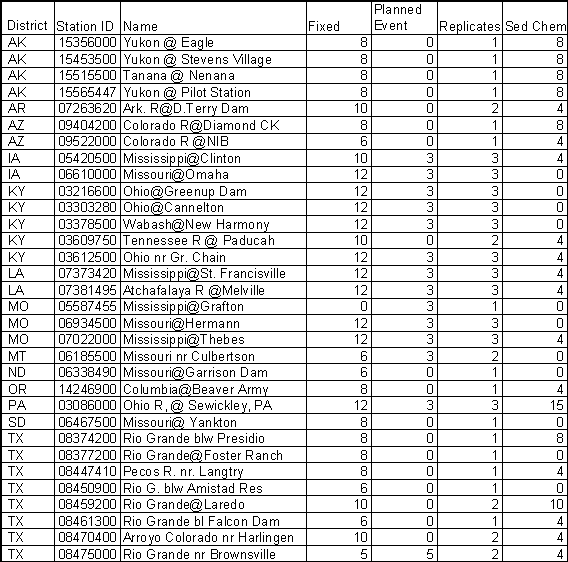
Table
1 also contains the sampling frequency for all stations, including the
"fixed" samples whose collection costs are made in an initial
transfer at the beginning of the year and the "event" samples.
Collection costs for event samples are reserved until samples are collected to
provide greater flexibility to the program. These funds will be transferred in
July, 2001. Detailed sampling schedules will be released with the Operations
memo at the NASQAN meeting.
There
will be greater variation among stations this year concerning which
constituents are measured. The final column of Table 1 indicates the number of
large volume samples to be collected for sediment chemistry analysis of trace
elements. In general, after a site has been adequately characterized, no
further sediment chemistry is collected, with the exception of a few key locations
in each basin.
Table 1. NASQAN Stations operated in FY
2001 with sampling frequency.
Initial Funding
Transfer
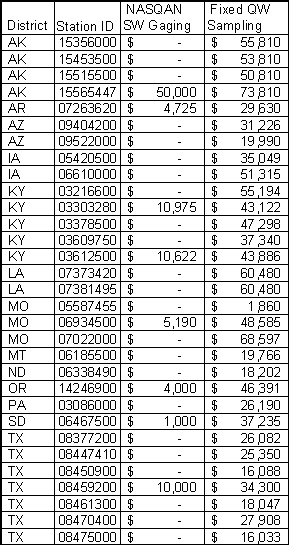
The
amount of the initial transfer is shown, by District and by station, in Table
2. These figures reflect cost estimates
provided by the Districts in August, 2000. Although these amounts reflect the
estimates in gross funds as provided at that time, OWQ reserves the right to
adjust the funding if overhead rates change during the year.
The
"Fixed QW Sampling" figures shown in the attached table should be
entered on the CBR request frame in AIS as your request for FY 2001
water-quality funding. Where applicable, funding for surface-water gages is
shown in a separate column and should be entered into the appropriate request
frame.
Table 2. Initial funding
transfer for NASQAN stations.
Analytical Schedules
Although
there are no changes in the analytical schedules to be used this year, the
schedules have been changed to reflect changes in the analysis for dissolved
and particulate organic carbon. Different supplies will be needed this year for
these constituents. These issues will be discussed at the NASQAN meeting in
Jackson and in the FY 2001 NASQAN Operational Memo. "Central"
sediment labs will be used for all NASQAN samples to ensure data comparability
across the basins. All NASQAN samples from the Mississippi and Rio Grande
Basins should be sent to the Iowa Sediment Lab; Columbia, Colorado and Yukon
samples should be sent to CVO.
Laboratory
Charges
Both
National Water Quality Laboratory and Sediment Laboratory Charges are directly
billed to NASQAN using the appropriate basin account number. Sediment lab
charges are not included in the funds being transferred to the Districts,
although shipping costs have been included in the transfer.
Account
numbers that should be used are:
Yukon
River 4883-15010
Colorado
River 4883-15020
Columbia
River 4883-15030
Mississippi
River 4883-15040
Rio
Grande 4883-15050
These
account numbers are to be used only for laboratory charges and not for
supplies, equipment or other costs. (Funds for those items have already been
included in the amounts transferred to the Districts.) Any charges to these
accounts directly by Districts will be rejected. Any extraordinary expenses
must be discussed with Rick Hooper. Once approved, funds will be SV'd to
Districts to cover such costs.
Program
Coordination
Each
NASQAN basin has a "Basin Coordinator" who is the primary contact for
operational questions. For FY 2001, the basin coordinators are:
Mississippi
Basin: Richard Coupe (rhcoupe), Jackson, MS; (601) 933-2982
Rio
Grande Basin: Dee Lurry (dllurry), Austin, TX; (512) 873-3071
Colorado
Basin: Bob Hart (bhart), Flagstaff, AZ; (520) 556-7137
Columbia
Basin: Valerie Kelly (vjkelly), Portland, OR; (503) 251-3244
Yukon
Basin: Tim Brabets (tbrabets), Anchorage, AK;
(907) 786-7105
Rick Hooper (rphooper; Northborough, MA; (508/490-5065) serves as the National Technical Coordinator, and is the primary contact regarding budget questions.
Janice
R. Ward
Acting
Chief, Office of Water Quality
This
memorandum supersedes OWQ Technical Memorandum 2000.01.
Distribution: A, B, DC, AO, District Water-Quality Specialists, and Regional Water-Quality Specialists